Demand

Is the NHS under-resourced to deliver what is asked of it? Estimates from august think tanks and national audits describe that it is, the scale of the under-resourcing and the deficits in staffing and infrastructure created. The Darzi report identified a £11.6bn backlog in capital expenditure in the NHS in England. We have fewer beds (2.4 vs 4.3 per thousand), doctors (3.2 vs 3.7 per thousand) and scanners (19 vs 41 per million) than our OECD comparators. To keep pace with demographic changes, new technologies and drugs and the increased use of some surgical procedures, it’s estimated healthcare provision should increase 4% year on year. All OECD countries struggle with increasing healthcare spend.

Radiology services are on the sharp end of this demand growth. Imaging demand is increasing year-on-year at about 5% in the UK. For complex cross sectional imaging, demand growth was 11% in 2023 alone. Unplanned and out-of-hours imaging demand has increased 40% in 5 years. It’s rare for a clinical initiative or guideline to suggest we need less imaging, or less urgent imaging. Getting it Right First Time usually requires early imaging to make certain an uncertain clinical picture. The development of new therapies often mandates more, and more frequent, imaging.  The Richards Report indicated that a 20% increase in imaging delivery was needed.

Can we control this healthcare growth? The idea of demand control in healthcare is fraught with complex ethical and moral dilemmas about access to treatment, the nature of the doctor-patient relationship and the needs of the individual versus those of the collective. The language we use (‘rationing’, ‘postcode lottery’, ‘playing God’) and powerful stories about individuals or groups denied care on the basis of decision making by ‘faceless bureaucrats’ means that rational debate about demand management in healthcare is challenging. Demand management calls into question what we mean by comprehensive healthcare and how society should respond to the needs of vulnerable people.

Even discussion about prevention and public health, effective and on-the-face-of-it uncontroversial ways to improve population health and thereby control demand long term, is freighted with unhelpful language (‘nanny statism’) and arguments about personal liberty and choice (the latter supported by powerful corporate lobbyists whose interests are risked by state interventions for smoking, alcohol and obesity). Initiatives targeting the most needy and aimed at equitable (rather than equal) resource distribution are sometimes denigrated as ‘woke’.

In the financial year 2022-23, the UK government spent £239bn on healthcare (mainly on the NHS), 18% of the total public-sector spend and 11% of GDP. At 4% growth in 10 years time this figure will be (a back of the envelope calculation) 50% greater. Healthcare spending, often protected, has already increased at the expense of other government departmental spending (especially defence – see figure) with little further room for cannibalisation of other budgets. The often advocated narrative of economic growth to deliver spending resource seems a forlorn and remote aspiration given anaemic growth figures for the UK and most other advanced economies over the last decade.

Health (green) and defence (magenta) spending as share of GDP 1955-2021

Figure source: Institute for Fiscal Studies Taxlab. What does the government spend money on?


There are undoubtedly productivity gains to be made and in radiology many potential solutions are well rehearsed: comprehensive and careful request vetting, electronic systems to support it (and to feedback to referring colleagues), decision support tools (such as iRefer) at the point of request and visibility of requests and booked scan appointments within the electronic patient record are all technical innovations that can improve a requesting culture, reduce duplication and deliver marginal reductions in demand. Skill mix and better use of radiographer reporting can help with workload and is already well established for some teams and imaging types (especially ultrasound and plain film imaging). Perhaps artificial intelligence will finally deliver its promise? Will this be enough? I doubt it.

So how can we deliver? With our current model of healthcare, ultimately, we will not be able to. The spending graphs for healthcare as a proportion of GDP extrapolate to this inevitability. Without rethinking the model, services will fail, little by little and around the edges at first in a myriad unplanned ways. The deterioration will manifest as longer waiting times and failure to meet constitutional and other standards, increases in falls, failures in infection prevention and control, loss of access for marginalised groups, estate degradation, workforce crises, increased complaints and litigation and in other, sometimes immeasurable, important ways. Does this sound familiar? It’s happening already. The irony is that as we spend more on increasingly expensive, process focussed, fractured and technology driven healthcare, we deliver less health and the experience of service users deteriorates. Healthcare delivery is more than just logistics.

We cannot address delivery without controlling demand in a systemwide manner. This especially applies to complex new therapies, imaging and drugs (which are the primary drivers of increased spending). Practical demand management is hard because we assume more healthcare equals better health, are beguiled by technology, no longer understand risk and are wedded to pathway solutions that reduce some of the intangibles of the human interaction between a patient and a healthcare professional to nodes on a decision tree from which every branch results in more to do. It is also hard because our political structures rely on promises made in a brief electoral cycle, subordinating the ability of our institutions to undertake long term planning. Complex decisions like those that are needed to equitably and ethically address demand are ignored because there will be politically unpalatable losses in the medium term while the wins may take many years to manifest. 

What’s the solution? A massive funding pivot to primary care and its ability to resolve many simple issues quickly, cheaply and effectively? Removing healthcare delivery from governmental control altogether, sacking the Secretary of State and assigning a fixed proportion of GDP for 25 years to allow long term planning? Addressing the social determinants of health: education, housing, lifestyle choice, opportunity, inequality? Robust implementation of cost-effectiveness principles in healthcare design? Public education about risk? Promotion of a stoic understanding of what it means to live a good life, knowing that death is inevitable? 

If all that seems too far outside your zones of control or influence then perhaps in your day-to-day practice take a moment to consider the things you can change. Each time you make a decision, ask yourself: is this test, treatment, referral or innovation really needed? Who am I treating, the patient or myself? Is it easier to do the wrong thing than the right thing and if so, why? Am I too busy to think about this? Am I too proud or too anxious to ask for help? We all have a role to play in identifying pointless, wasted or supplier-induced demand.  Making better small decisions every day is achievable and accumulations of hundreds of thousands of tiny marginal gains can have a big effect. This will not be sufficient on its own, but it’s necessary, vitally so.

Demand. It’s the elephant in the room of healthcare funding. Ignore it and sooner or later we’ll all be trampled. It’s our urgent responsibility as healthcare professionals to act to control demand, even if our government seems unable to.


The burden of knowledge

When I was learning my trade as an interventional radiologist, decisions seemed easy. I did what my supervising consultants told me to do. Shall I put a stent in this vessel, undertake this aneurysm repair, do this embolisation? These were easy questions, with the same easy answer. If the boss says do it, then do it. Along with this simplicity came an easy and beguiling belief that I was doing the right thing – by my patient, by wider society and by my profession. The challenges were technical. Was I a good enough operator to do the procedure well? Could I establish rapport with the patient sufficiently for them to trust me to do it? Was there a complication and if so, what had I learned from it? Nuances of hand-eye coordination, positioning, device selection, team management all developed within this context. This was the ‘cutting well’ of the old surgical adage, ‘choose well, cut well, get well’.

As I approached the end of my training, and in the early years of my consultant practice, cutting well became a given, or at least enough of a given that my complication rates did not raise concerns amongst my colleagues. I was definitely not the most skilled, patient or creative of my colleagues but I was (and I hope remain) hard working, conscientious and reflective, enough to be welcomed as a productive member of the team. 

My experience grew, and the technicalities of the procedures became easier as conscious expertise became subconscious. But the work became more difficult absent the safety blanket of a supervising colleague. Choosing well was complicated. The more I read the literature, the more difficult choosing well became and the less sure I was that my choice was correct. How does the literature I’ve read represent this patient? Is my interpretation of it right or have I got the wrong end of the stick? What about the literature I haven’t read? Should I stent this vessel? Use this device? Treat this patient? These decisions increasingly became a cognitive battle with myself: in the outpatient department, when vetting referrals or (worse still) in the middle of a procedure.

But I still felt secure that the wider perspective was that I was doing good work. I was helping my patients and was contributing to the health of the society in which I live. My patients seemed happy after their interactions with me. My outcomes were satisfactory, I was respected by colleagues for my clinical decision making. I felt fulfilled, important, imbued with purpose and professional value.

I continued reading and attending conferences and symposia. I started peer-reviewing. And like watching a play or reading a novel, I became increasingly familiar with the characters and the wider professional landscape. And slowly and surely doubt insinuated itself into my thinking. What were the motivations behind this publication? Why did they choose this study design, outcome measure or results interpretation over that one? Are there vested interests and who do they serve? The more my knowledge and experience grew, the more I became worried choosing well not only applied to some patients but to whole classes of procedure. Does the evidence justify us doing this procedure at all? And if it does, is the size of the effect sufficient for me to be clear I am helping this patient, with all the personal and professional satisfaction that comes with that. It’s hard to maintain the hubristic illusion of the brilliant life (or limb) saver as the number-needed-to-treat (NNT) creeps up. If the NNT is 10, which of the ten patients are you helping? Which are you harming? In which does it make no difference at all? What does treating this patient mean for that patient? Those patients? Everyone? I felt my identity was a house of cards, ready to collapse at any moment, like a priest losing his faith as he questions the relevance of Theology the more of it he reads.

I wondered if I was experiencing burnout, but I remained able to empathise with my patients, perhaps more so than before. I spent longer with them, discussing the uncertainties, my uncertainties, about what the right thing to do was. I think our shared decision making got better. I was not exhausted or mentally drained, but I did feel a gnawing anxiety about the cognitive gap opening between my thinking and where I had come from.

As I enter what is likely to be the final decade of my practice, I am burdened with a deep sense of uncertainty about my chosen specialty and about technocratic medicine in general.  We rarely ask the questions I am increasingly preoccupied by: what is technologically advanced healthcare for? Who benefits? What can we afford and what do we choose to afford? Why? Is nudging someone from one survival curve to another slightly shallower curve sufficient reason to undertake an intervention? I belatedly realise the specialist literature of my field often fails to consider these big issues, rather focussing on the issues of technique and narrowly defined benefit. Worse when faced with broader questions (Why? What for? So what?) they are frequently framed or perceived as a threat.

Where does this leave me? Does this realisation make me wise? A dreary cynic? A sensible counsel to the exuberance of my more youthful colleagues or a curmudgeonly Luddite to whom all progress is anathema? I shall leave it to those who know me to answer those questions. But it seems to me essential that we engage with questions about why. Until we do we risk some of modern therapeutic medicine becoming elegant technique in search of a disease.

Values, guidance, NICE and the ESVS.

This is a transcript of a 7 minute talk I was invited to give at the Cardiovascular and Interventional Society of Europe’s [CIRSE] annual conference in Barcelona, as part of a session on “Controversies in Standard Endovascular Aneurysm Repair [EVAR] within IFU” [indications for use].

This talk: “NICE guidelines best inform clinical practice”, was one side of a debate: my opponent’s title was “European Vascular Society [ESVS] guidelines should be the standard of care”.

If you have on-demand access to CIRSE2022 content, you can view a recording of the session here.

Barcelona. Spain. 13th September 2022. 15:00h

Thanks. My name is Chris Hammond, and I’m Clinical Director for radiology in Leeds. I was on the NICE AAA guideline development committee from 2015-2019.

I have no declarations, financial or otherwise. We’ll come onto that in a bit more detail later.

This talk is not going to be about data. I hope we are all familiar with the published evidence about AAA repair. No. This talk is about values. Specifically, the values that NICE brings to bear in its analysis and processes to create recommendations and why these values mean NICE guidelines best inform clinical practice. What are those values?

Rigour, diversity, context.

Let’s unpick those a little.

NICE’s is known for academic rigour. Before any development happens, the questions that need answering are clearly and precisely identified in a scoping exercise. A PICO question is created, the outcomes of interest defined, and the types of evidence we are prepared to accept are stipulated in advance. 

The scope and research questions are then published and sent out for consultation – another vital step.

After the technical teams have done their work, their results are referred explicitly back to the scope. Conclusions and recommendations unrelated to the scope are not allowed.

This process is transparent and documented and it means committee members cannot change their mind on the importance of a subject if they do not like the evidence eventually produced. 

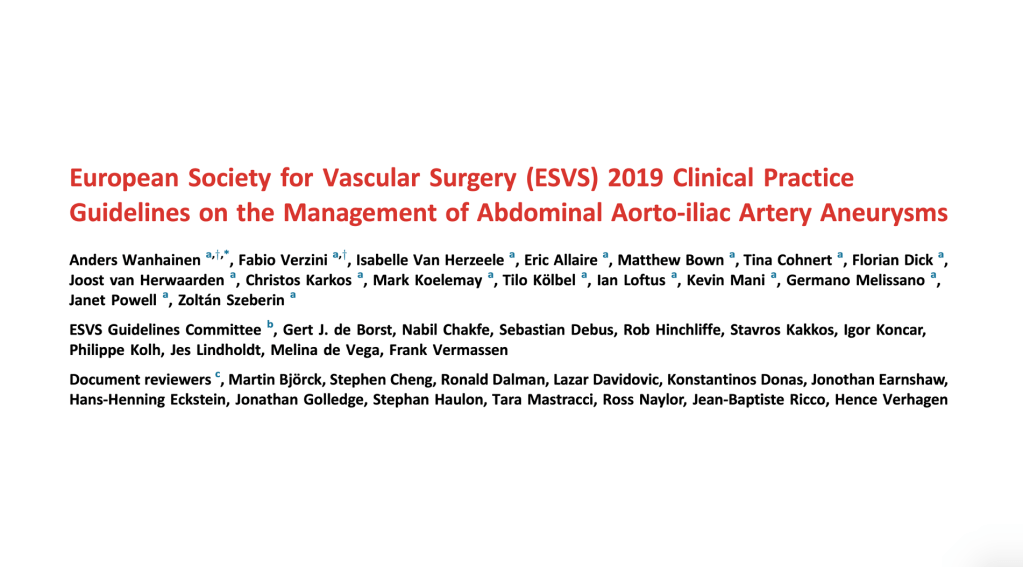
It’s impossible to tell from the ESVS document what their guideline development process was. A few paragraphs at the beginning of the document are all we get. ESVS do not publish their scope, research questions, search strategies or results. How can we be assured therefore that their conclusions are not biased by hindsight, reinterpreting or de-emphasizing outcomes that are not expedient? 

We can’t.

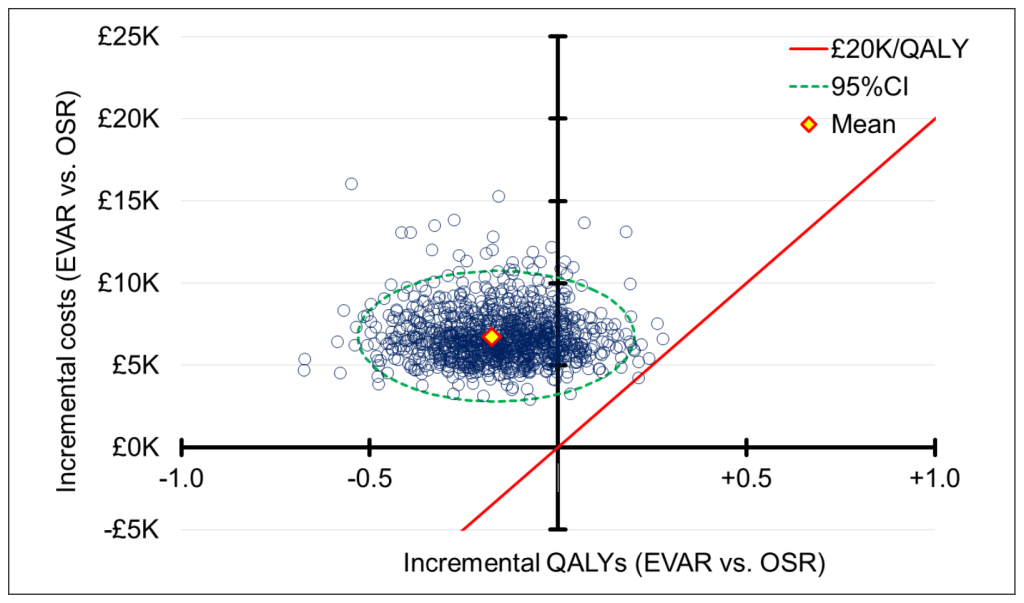
For example, data on cost effectiveness and outcomes for people unsuitable for open repair are inconvenient for EVAR enthusiasts. I’ll let you decide the extent to which these data are highlighted in the ESVS document.

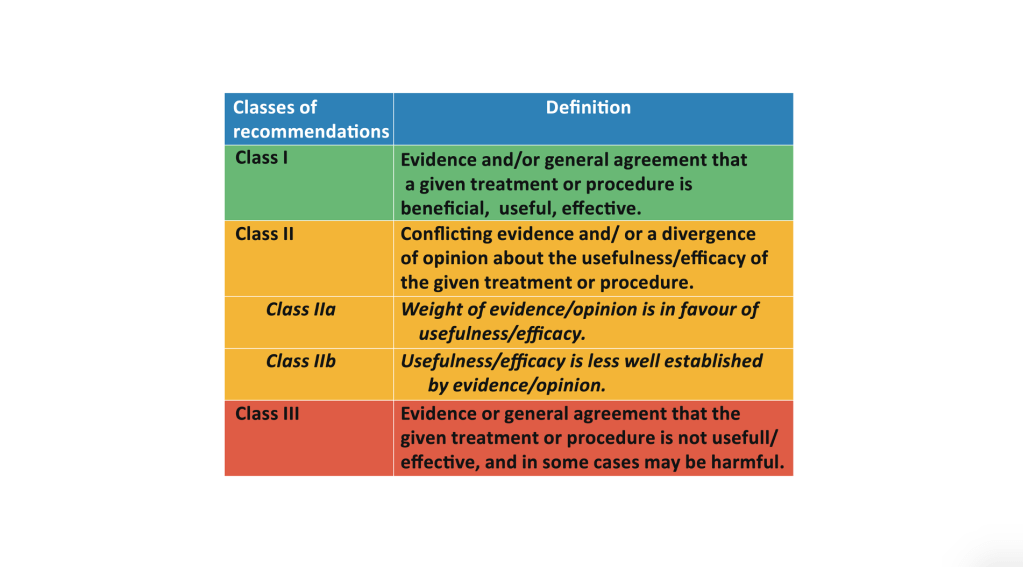
More, in failing to define the acceptable levels of evidence for specific questions ESVS ends up making recommendations based on weak data. Recommendations are made based on the European Society of Cardiology criteria which conflate evidence and opinion. Which is it? Evidence or opinion? 

Opinions may be widely held and still be wrong. The sun does not orbit the earth. An opinion formulated into a guideline gives the opinion illegitimate validity.

Finally, there is the rigour in dealing with potential conflicts of interest. These are the ESVS committee declarations – which I had to ask for. The NICE declarations are in the public domain on the NICE website. Financial conflicts of interest are not unexpected though one might argue that the extensive and financially substantial relationships with industry of some of the ESVS guideline authorship do raise an eyebrow. 

The question though is what to do about them. NICE has a written policy on how to deal with a conflict, including exclusion of an individual from part of the guidance development where a conflict may be substantial. This occurred during NICE’s guideline development.

The ESVS has no such policy. I know because I have asked to see it. Which makes one wonder: why collect the declarations in the first place.

How can we then be assured these conflicts of interest did not influence guideline development, consciously or subconsciously.

We can’t

What about diversity? 

This is the author list of the ESVS guideline. All 15 of the authors, all 13 of the document reviewers and all 10 of the guideline committee are medically qualified vascular specialists. They are likely to all have had similar training, attended similar conferences and educational events and have broadly similar perspectives. It’s a monoculture. 

Where are the patients in this? The ESVS asked for patient review of the plain English summaries it wrote to support its document, but patients were not involved in the development of scoping criteria, outcomes of importance or in the drafting of the guideline itself.

Where is the diversity of clinical opinion? Where are the care of the elderly specialists to provide a holistic view? Where is anaesthesia? Primary care? Nursing?

Where is the representation of the people who pay for vascular services:  infrastructure, salaries, devices? And who indirectly pay for all this, maybe for your meal out last night, for the cappuccino you’ve just drunk? Where is their perspective when they also have to fund the panoply of modern healthcare?

NICE committees have representation of all these groups, and their input into the development of the AAA guidance was pivotal.  The NICE guidance was very controversial, but the consistency of arguments advanced by diverse committee members with no professional vested interest was persuasive.

Finally, we come to context.

An understanding of the ethical and social context underpinning a guideline is essential.

We cannot divorce the treatments we offer from the societal context in which we operate. We live in a society which emphasises individual freedom and choice and are comfortable with some people having more choices than others, usually based on wealth. Does this apply equally in healthcare? In aneurysm care? What if offering expensive choices for aneurysm repair means we don’t spend money on social care, nursing homes, cataracts or claudicants.

To what extent should guidelines interfere with the doctor-patient relationship? Limit it or the choices on offer? What is the cost of clinical freedom and who bears it?

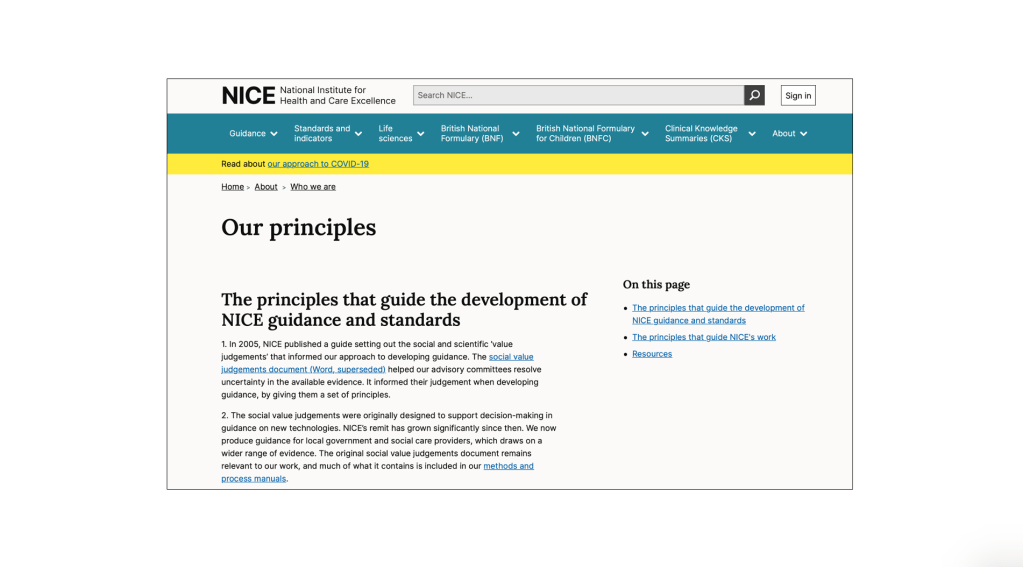
NICE makes very clear the social context in which it makes its recommendations. It takes a society-wide perspective, and its social values and principles are explicit. You can find them on the NICE website. Even if you don’t agree with its philosophical approach, you know what it is.

We don’t know any of this for the ESVS guideline. We don’t know how ESVS values choice over cost, the individual over the collective. Healthcare over health. This means that the ESVS guideline ends up being a technical document, written by technicians for technicians, devoid of context and wider social relevance.

The ESVS guideline is not an independent dispassionate analysis, and it never could be, because its development within an organisation so financially reliant on funding from the medical devices industry was not openly and transparently underpinned by NICE’s values of rigour, diversity and context. 

Rigour. Diversity. Context

That’s why NICE guidelines best inform clinical practice.

Thanks for your attention.


Cost-effectiveness, art and science in medicine

I’m consulting with a man in his mid 70s: a retired teacher in an inner city secondary school. He used to smoke, but quit several years ago. He’s otherwise pretty fit: he has never learned to drive so walks everywhere and uses public transport. He is married, and his wife and he are still independent. They have grown up children who live a long way away. They go out to the theatre when they can and enjoy going to the local pub together and with friends. He’s got high blood pressure which is well controlled. He also has an abdominal aortic aneurysm (an AAA). It’s large. And he is worried about it. We talk about the options for repair. He is anxious about a major abdominal operation. He’s not dead set against it, but is concerned about the recovery, the impact it will have on his wife. On balance he is minded to have an endovascular repair, for which the AAA is anatomically suitable. We discuss the long term outcomes of open and endovascular repair. The need for secondary procedures and surveillance. He leaves the consultation undecided and plans to discuss it with his family.

I have spent the last 5 years on the NICE Guideline Development Committee, developing a guideline for the management of people with AAA. The results of several large trials comparing open and endovascular repair of AAA are consistent that while endovascular repair and open repair are safe (meaning very few people die from them), endovascular repair is safer by a small margin and gets people out of hospital and back to normal substantially more quickly than open surgery. However the longer term outcomes are not as good and beyond about 7 years, more people are dead after endovascular repair than after open repair. Because of this, endovascular repair is not cost effective, meaning the opportunity cost of providing it is too great and at a population level offering endovascular repair causes harm. Putting aside arguments about the contemporary relevance or methodological detail of the evidence, the only possible conclusion is that endovascular repair should not be undertaken if someone can have an open operation.

There are several problems with accepting this analysis. One is that it requires a belief that savings made in one place in the healthcare economy will be realised in a benefit elsewhere: something called Pareto efficiency. This might be an intellectual leap too far for some in the NHS of 2020. But perhaps the biggest issue that it is a cold joyless analysis – a faceless functional accounting, the reduction of individual encounters to marks on a Kaplan-Meier chart. It is the science in medicine, but medicine is more than science. It’s an art. For me some of the joy of practicing medicine is in this art: the ability to synthesise the evidence into a narrative a patient can engage with, helping them work out the best option. What do I do then, when having done this, my patient’s preferred option is not cost effective, when the art and the science collide? How do I decide between the interests of a real person sitting before me, vulnerable, perhaps anxious, who trusts me to make decisions with them, for them and in their best interests and the interests an unknown person (or group) with whom I have no relationship – the people who will theoretically benefit if I choose the science over the art. How do I decide between my patient and society?

Since the publication of the draft NICE guidance on AAA, which recommended against endovascular repair partly on the basis of cost effectiveness arguments, I have defended and explained the decisions the guideline committee made at conferences, in conversations and in print. I have posed questions to conference panellists who were challenging the guideline about whether they think cost effectiveness is an important consideration when deciding a therapy and received frequently unconvincing responses. But in the back of my mind, I’m questioning: are they right? Are the unseen consequences of my clinical decisions (for unknown people) my responsibility or are these too distant from me to consider. 

Within the contexts by which NICE asks its committees to make decisions, the answer is clear: they are not too distant, and must be taken into account. But while it may be the right thing to do, to follow the science and deny treatments that are not cost effective, it can feel wrong. It’s a depressing analysis to frame the future for individual people in terms of population outcomes. Individual characteristics, ambitions, concerns and expectations, love, beauty and hope are subordinated to the inevitable logic of the data. This feels like a betrayal of the doctor-patient relationship which is ultimately a personal one: and guidelines are implemented at a personal level, patient by patient. 

This is not a new dilemma, either in medicine or in economics in general. It is a version of ‘the tragedy of the commons’. To some extent patients, the public and physicians understand it, in the general acceptance of triage in emergency departments, or waiting lists for elective treatment. But the idea of not offering treatments at all, solely on the basis of a cost effectiveness calculation, seems to be too much for many people in their role as clinicians or patients, even if it makes sense in their role as taxpayers. In fact it is probably impossible (and certainly not desirable) for clinicians to make bedside judgements on the basis of cost effectiveness, not only because of how it makes them feel, but also because it would undermine the trust central to the relationship with their patient. Solutions to the dilemma attempt to constrain the options available to clinicians either by incentivising certain therapies, or by limiting choice to cost effective options only (by either not funding the alternatives or by creating guidelines). In order to allow these solutions, clinicians need to accept that some decisions are taken out of their hands. But in doing this, it can seem as if the art in their practice is reduced to a near irrelevance. Perhaps this, then, is one of the reasons for the criticism, even resentment, of some of NICE’s draft AAA guidance.

Where does this leave us? We are caught in the cleft stick of increasingly costly technological advances in healthcare, wanting to offer them to our patients where appropriate, but understanding that ultimately resources are finite. We will need to face this as a society and as individual clinicians sooner or later unless healthcare costs are to escalate uncontrollably. We surely need to understand that the technical advances that interest us may not be in the best interests of society at large, and accept this where it is the case. We need to allow trusted organisations to make these decisions for us, within an open and transparent process, and we need to allow that the art in medicine (and our joy in practising it) is retained but refocussed to help our patients navigate their therapy choices within the constraints imposed on us by those trusted organisations. NICE’s failure to stand firm on its principles in respect of this aspect of the AAA draft guidance sets an unfortunate precedent and makes these issues more difficult, not less.

My patient returns to clinic. He has spoken with his family and his wife. He wants an endovascular repair. Cognitive dissonance rages within me. I take a deep breath in, and begin….