Last week, with some trepidation and nervousness, I attended a reunion. A reunion of people who, over three decades ago spent three to six years in each other’s company at university. A reunion of long forgotten relationships and barely recalled events. A reunion that, mathematically at least, given the time we spent together and the time since, should not have mattered more than an interesting diversion, a trip for a weekend in Oxford, an opportunity for me to wear my Black Tie, meet a few old compatriots, drink some wine and saunter around the Dreaming Spires admiring the architecture I ignored all those years ago.
So when I walked through the porter’s lodge of St Hilda’s College, unrecognisable from the place I anxiously approached in early October 1990 to present my first ever essay (“The Functions of the Fibroblast”), I was completely unprepared for the sudden wave of emotion that utterly enveloped me. Because this was not, in fact, a reunion of three-decade strangers. It was a reunion of people who shared a livid, intense, sometimes exhilarating, sometimes depressing, always exhausting and almost uniquely privileged experience. This was my medical school reunion.
We grew up in those years together: not just in the time we spent in each others’ pockets, but also as we transformed, becoming something new: men from boys, women from girls. Doctors from schoolchildren. Formed on the wards and lecture halls, operating theatres and labs, dissection tables and coffee tables from wide-eyed and excited sixth-formers into the footsoldiers of healthcare.
Those were tough times: long days, hard work, ridiculous exam questions with almost no relevance outside the cloistered enclave of Oxford academia (“How valid is the concept of the canonical neocortical circuit?”), volumes of information I struggle to recall even a fraction of. How important it all seemed then and how little of it I use now. But we had each other and we shared and laughed and partied hard.
Meeting up again felt like a window onto a lost world and was quite overwhelming: these old (-ish? – er?) men and women, celebrating their shared youth and collective experience. We are all closer to the end of our lives than the beginning, much closer to the end of our careers (and perhaps our meaning) than the beginning. We are now mature, maybe a little careworn, a little frayed at the edges, each with our own mental or physical battle scars from five-plus decades alive. Some scars visible, some hidden, some shared, some only hinted at, some, presumably deeply private, reflected in a furrow of the brow, a deeper wrinkle at the corner of the eye, a slight sadness in a smile. More interesting now as people bearing the patina of a life in healthcare (we are mostly still in healthcare) than the shiny clear skinned naive youths we were, arriving in Oxford in 1990 with utterly no idea of what we had signed up to.
How quietly content, and unapologetically self-assured we seem, each comfortable in his or her skin. Was there an unspoken shared wisdom? A resilience built by those experiences we have all almost certainly been through: seeing suffering, fear, new life, death, triumph over adversity or defeat in its face. Fantastic teamwork, mind numbing physical exhaustion, burnout, collaboration. Blood, pus, tears, sweat. The visceral thrill of a life saved, even if only for a short time; the pain, regret, self-doubt and introspection of a failure or a mistake.
Do other careers accumulate this wisdom or is this perhaps unique to a career in healthcare? What does a reunion of war veterans feel like? Is that a fair analogy? Are we veterans in healthcare? Is what I am describing a kind of shared PTSD, because no-one but healthcare practitioners see some of the stuff we see, so often, with the only support on offer (at least historically) gallows humour, each other, and alcohol. “Feel free to cope”.
You’d expect this in any gathering of doctors of a certain age, but the difference last weekend was that we knew each other before we’d acquired this wisdom. We were clearly the same people in mannerism and (mostly) appearance, but also all changed. Changed utterly. The inexorable passage of time and its influence on those bright young things from long-ago almost palpable. Time both running out like sand through fingers, but bringing something different: refining, growing, evolving. Thinking back on it now raises an unexpected but somehow comforting lump in my throat. Writing this has brought, again, tears to my eyes.
I’ve learned a lot since I left medical school: I can report a chest radiograph (well, I probably can’t any more), I can punch a new channel through someone’s liver from their neck, I can fill a tumour with plastic beads. But the enduring lessons, the important ones, the ones that keep me going when my mood darkens, when my reserves of energy or my emotional capacity run dry are the ones strengthened by the bonds of experience at medical school and from the people around me. Friendship, support, empathy, laughter, kindness. Love.
To my friends from the classes of 1990 and 1993, and to those in those years with whom I barely shared a word, then or last weekend, I am so privileged to have spent that time with you. Thank you.
I have been a medical leader and manager for a few years now: an unexpected late career segue born initially out of necessity but latterly something I very much enjoy: the broadening of perspective as I have moved from consultant vascular radiologist to my current role has been revealing.
One of the things I have learned as I have moved deeper into this role is that communication between front-line colleagues and organisational management can be better. We sometimes seem to speak at cross purposes, misunderstand motivation or are not clear about expectations. In order to bridge this gap, here are ten tips to make sure you get the most out of your conversations with leadership and managerial colleagues.
Healthcare leadership is busy and a lengthy brain dump is a heart-sink. Try to keep your communication short, pithy and to the point. Can you summarise, in a format that is digestible on a trip between floors, why the recipient of your communication needs to care as much about it as you do? This ‘Elevator Pitch’ may seem like a corporate Americanism but forcing yourself to focus on a core message is a good habit for public and private sector employees alike wherever they live. Spend some time condensing and refining yours, and if you cannot, ask yourself whether you really understand the problem.
There’s a difference between a business case, a board level paper and less formal communication like email but even complicated documents are often longer than they need to be. TL:DR is real, especially when a document consistently uses a paragraph to say what could be said in a sentence so if you want your document to be read by a human, keep it tight. If necessary you can make complexities accessible in an appendix without them getting in the way of the broader theme or argument.
2. Keep it simple
You are a subject-matter expert. Your leadership or managerial colleague may not be. Pathways, acronyms and technical terms are hard to digest and are a barrier to understanding so keep the language simple and precise and don’t assume knowledge. Even if you don’t use a formal SBAR (Situation, Background, Assessment, Response) format, bear these categories of information in mind when communicating, and don’t mix them up. Take your time to think what you want in response and ideally put that at the beginning. Do you want a decision? Some support? What is the purpose of the communication?
If you are sending an email, think about your addressee list, especially the carbon copy (Cc:) field. Are you Cc’ing someone in for a reason or is it just a habit? I’ve experimented with an automation that moves all emails into which I’m Cc’d out of my inbox into a separate folder that I only rarely review. I don’t think I have missed anything vital though there has been the occasional surprise.
3. Understand risk
One of the biggest challenges managing in healthcare is balancing risk across diverse operations, or more thematically between the fundamental ‘pillars’ of quality, finance, workforce and safety. Accurate and broadly comparable assessments of risk are vital to support decision making and prioritisation, especially when resources are tight.
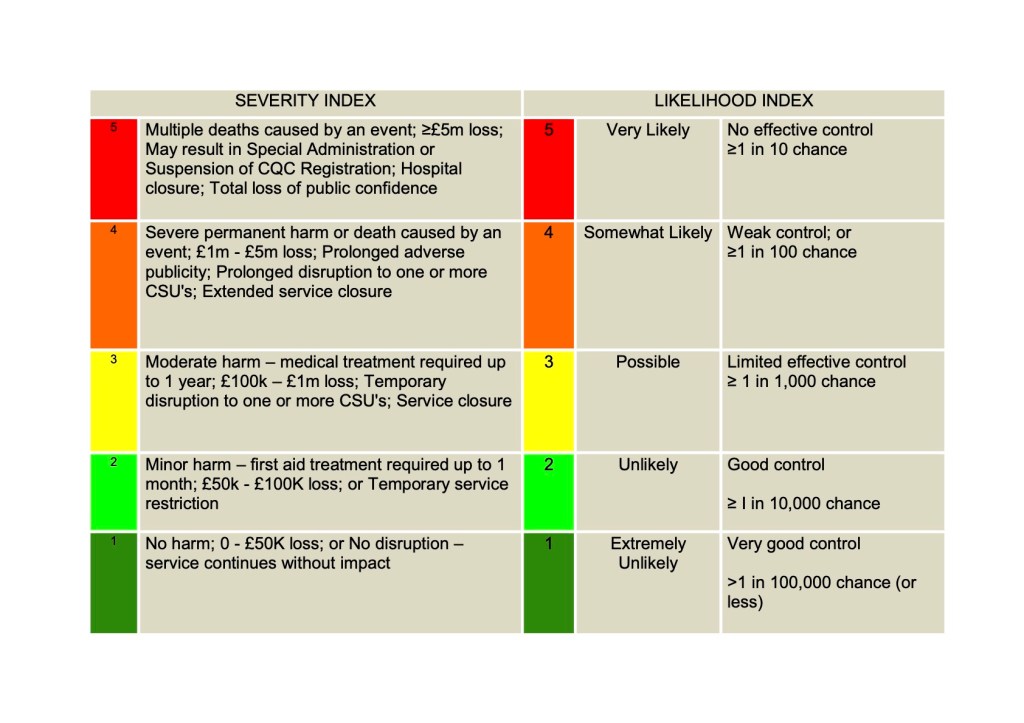
Your organisation will almost certainly have a risk matrix like this:
Learn how to use it and score risk correctly. Don’t artificially elevate your risk scoring in the hope this will get your issue noticed: crisis framing or shroud-waving is understandable behaviour when resources are tight but they undermine trust and confidence and longer-term render risk scoring useless. Something that’s scored at 25 is going to grab attention because that means there is a substantial or imminent risk of multiple deaths or closure of the entire hospital. Such risks are, in reality, rare in peacetime but are not uncommon in risk registers! If everything is important then nothing is.
4. Quantify
How big a problem is the thing you are talking about. Numbers are much more useful than adjectives, because one person’s ‘substantial’ is another person’s ‘marginal’. There is lots of data in healthcare: use it. Your department is likely to have accountancy, human resources and business staff who will have access this data and can help you.
If you are seeking resource, describe not just what you want but how much you want of it. Why have you settled on that amount and not half as much, or double? Be prepared to justify your request with modelling, a demand-capacity analysis or some other careful assessment. The larger the investment requested, the more rigorous the review of this will be so avoid guesstimates!
Quantification does not guarantee success: the narrative justification is just as important. But a narrative without data is just a story and is likely to be insufficient to generate enthusiastic leadership support.
5. Don’t use email for important communication
Email is terrible. There is so much of it and it’s hard to separate the signal from the noise. There are technical solutions to better communication (eg. apps like Slack, Teams or Monday) but unless your organisation makes a concerted pivot to one from another, they end up just being yet another channel to monitor.
If you have something important to communicate, pick up the phone or better still, arrange a meeting rather than clattering out an email. This gives the recipient a clue that this is something you feel warrants your time and therefore, perhaps, theirs.
Sending an email is rarely an action in itself or a fix for an issue. Don’t think that by sharing your issue you have absolved yourself of responsibility for its solution. This is called ‘Passing the Monkey’ and is rarely well received. In less enlightened times such communication might have been met with an irritated response along the lines of “feel free to cope”!
6. Understand your agency and present a solution
It’s easy to slip into passivity in the hope that someone will fix a problem for you or parachute in to provide an answer. In fact that’s rarely a good idea: the role of a leader is frequently to facilitate a team developing an answer for themselves within the context of the organisation’s overall strategic ambitions and priorities.
All consultants and other senior medical, nursing and allied health professional staff have a leadership role and share responsibility for addressing issues arising in their work. They have considerable agency in developing solutions, modelling behaviours and creating cultures. It’s vital that colleagues recognise this agency and use it, rather than passively escalating and hoping a solution will be provided or imposed.
This is not to suggest that all solutions lie entirely within a team’s capacity to resolve. The expectation is that as a necessary starting point teams to do what they can, where they are with what they have. Ideally, a team will proactively seek solutions and then present them to managerial colleagues as an options appraisal or a clear analysis of operational gaps and will then co-create solutions with leadership and managerial colleagues to mitigate these.
In the same vein…
7. Collaborate
Many issues straddle organisational boundaries. Improving access to theatre might involve estates, specialty teams, finance, anaesthesia and portering. Creating a new pathway in ED for early discharge might involve radiology, community services, primary care and IT.
Much of my role at the moment is getting people together and facilitating (or chairing) a conversation. If you want to create something, get all the stakeholders together and talk. This is now easy with videoconferencing and is hopelessly inefficient over email. Make sure you have all the right people in the room and don’t make assumptions about others’ perspectives or allow other people’s assumptions to go unchallenged. Listen as much as you speak and ensure there are good minutes.
A well worked up proposal created collaboratively between teams and shared for a decision is preferable to a leader being asked to come in and referee a disagreement, especially where no real attempt at prior collaboration has been made.
8. Be prepared for compromise, and possibly rejection
When collaborating, you may find that what you had originally planned is legitimately not possible. There may be insurmountable resource implications, staffing issues or regulatory hurdles to overcome that you might not have even begun to consider.
Agree compromises and know their consequences (eg. with a Quality Impact Assessment). Describe them clearly and succinctly so that a leadership or managerial colleague can easily understand (and sometimes take responsibility for) the risk in the decision. Avoid being too rigid, especially if failure to compromise will risk an entire project. Leaders will be interested in the overall impact even if the consequences for some stakeholders are not optimal. Bear this in mind when deciding where to draw your compromise ‘red lines’.
Sometimes the decision may be ‘we can’t do that’. While this can be disappointing, it at least allows you to park a project and not waste time pursue something that is unlikely to reach maturity. Frame it as an opportunity to pivot to something else.
9. Put patients at the centre
When you are deep in the detail of a business case, an organisational change, a pathway development or some other project, it’s easy lose perspective and forget what healthcare is for and who it serves. What you propose is important, but if a leader asks ‘so what’ you need an answer.
Keep as your guiding principle the delivery of quality, accessible, safe and compassionate healthcare and maintain this focus in all your interactions. If you can clearly articulate the benefits to patients and service users of what you are doing, that makes a leadership decision to support it much easier. Your organisation will have a strategic goal which almost certainly will (should!) have patients and staff at its centre and leaders will want assurance that your project aligns with this.
10. Invest in the relationship
This is perhaps the most important tip of all: a good working relationship between leadership and managerial colleagues and the teams they lead is essential.
Trust, mutual respect, openness, honesty, reliability and understanding are essential for professional relationships to thrive and be productive. Without these attributes, all the tips offered above will fail. This does not mean only focussing on the positives and avoiding difficult issues: in fact the opposite is true. If you and your leadership colleagues can foster a culture where difficult conversations can be had in the same spirit of psychological safety as easy ones, if you can hold each other accountable and if you can give and accept challenge with an open and growth mindset rather than a closed fixed one you are well on the way to being a powerfully effctive team.
This doesn’t mean you need to socialise together or make idle conversation for 5 minutes at the start of every meeting: it means demonstrating behaviours, and expecting these behaviours in return, that will allow your relationship to flourish.
I go to a lot of meetings these days. A lot. Sometimes it’s difficult to keep track of who said what when, so I like to make notes. I’ve experimented (expensively) with many ways of making notes: typing, AI transcription, using an iPad or an ePaper device like the ReMarkable but I always come back to the centuries old solution of a pen and some paper. Like the joke about the difference between an American and a Russian Space Pen (one cost $1m to design and build, the other is a pencil), sometimes the simplest solution is still the best.
The choice of pen is another, possibly lengthy, discussion because like a pair of shoes, the pen you use says something about you if people care enough to notice (and you should probably only care about the people who care enough to notice). But for paper I like a hardback B5 notebook: classy, timeless and neither too small nor too big. My personal favourite is the Leuchtturm1917 range – others are available.
But notebooks have a disadvantage: they are books and finding those meeting notes down the line can be almost impossible, especially if you’ve gone through several. Which notebook? What page? Why can’t I read the writing? Where is the index?
Due to an unfortunate incident a month ago involving my bike, a greasy corner, a trip to ED and some cracks in my pelvic bones, I have been temporarily off work with too much time on my hands. So in an excellent example of finding things to worry about when I didn’t have anything to worry about (apart from pain, made manageable with very effective – and moreish – opiate analgesia) I decided my notebook-indexing problem was a thing that must be fixed and the solution to this was an app. But which app? None on the App Store seemed to do what I wanted representing either a massive gap in the market, or a sign (had I chosen to heed it) that in the grand scheme of things my problem was not top of the list of even first world issues.
But I persevered. Could I do something myself? So I asked an AI, Claude:
“Claude: can I use you to write an app for OSX? I have no programming experience myself but I can describe what I want the app to do.”
Of course the answer was yes. And so, in the absence of other work, and latterly alongside other work, the AI and I disappeared down an ever deepening rabbit hole. What started as an idle query in response to an idle thought arising from the idle time I had recovering from my injury, became something bordering on obsession as the app slowly materialised from the AI’s code, becoming progressively more polished and focussed to the point where a few days ago, suddenly, it was done: with a website, a page on the App Store (complete with marketing screenshots), an icon, a getting-started file and an upgrade strategy.
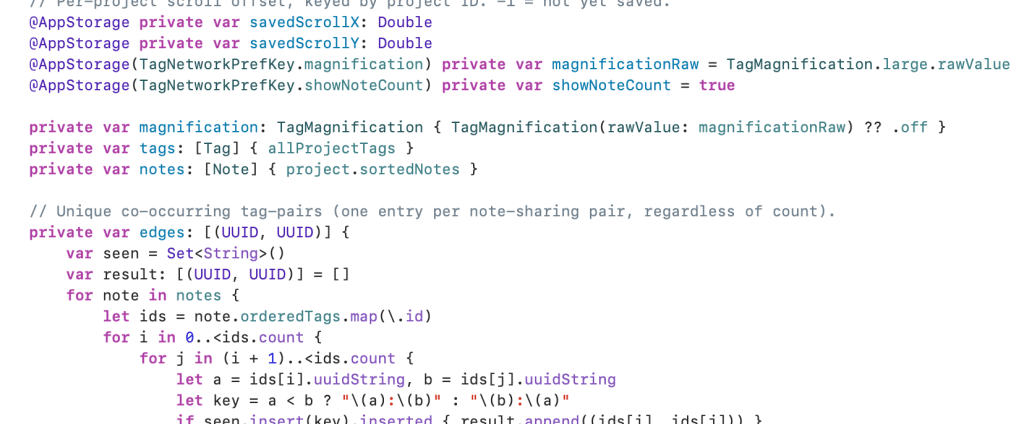
What was remarkable about this process was how easy it was: I have absolutely no programming experience other than writing clunky and inefficient code in SuperBASIC on my Sinclair QL in about 1986. The AI did all the writing, while I watched the token count tick over. I’d ask it to do something and it would produce monospaced colour coded lines of Swift instructions that were, to me, gobbledegook like:
However, the gobbledegook seemed to work and the app slowly, almost miraculously, took shape, eventually becoming something that did exactly what I wanted. I can index pages of my notebooks and find those pages later from within the app using tags or combinations of tags. Claude and I identified some other use-cases: the app could be used for creative writing, research or planning but I will happily admit it is a niche product. And while I am now a fully fledged, perhaps illegitimate (given my coding ignorance) app developer, enrolled in the the Apple Development Programme, I am also (in the considered opinion of most of my family and friends) a hopeless nerd.
What have I learned in this process?
The development was astonishingly easy. The barriers to developing the app without the AI would simply have been too high – was I interested enough to hire someone who could write code, to invest in their time and arrange meetings to review what they’d done. Emphatically no – this was a hobby project, a diversion from pelvic pain. Without AI, the app would not exist and humanity would perhaps have been… …well OK, no different.
The AI model wasn’t creative. It didn’t come up with ideas unless prompted specifically (“How do you think I should present my screenshots on the App Store?”). It would produce solutions but the wider ideas were mine. Sense checking the app’s human interface, deciding which features added value and which were distractions, and coming up with improvements on the initially very basic functionality was left to me. And while Claude was good at doing what was asked, it would sometimes get stuck in a programming doom loop going around in circles trying to fix something. It was up to me to decide when something wasn’t working or wasn’t worth the effort and pull it back (“This isn’t working, let’s go back and start again”).
Claude has a personality. For a UK user it can seem cloyingly exuberant and positive (“Great job”, “Good call”, “Great catch”, “Agreed”) though you can change this (“Be my sparring partner” gets a more assertive and in-depth analysis of the flaws in your thoughts) but it doesn’t criticise even when it has good reason to: when I asked whether I should patent my app, I think it might have legitimately snorted but instead came up with a (long) list of why this was not a good idea. Perhaps I’d have been more comfortable with an old fashioned British Cynicism and Passive Aggression mode.
But the most stark learning point, for someone who has been suspicious of AI, was how powerful and genuinely useful it was. I’ve since used it to review documents I have been writing and it has come up with real insights and legitimate viewpoints that I had not considered. I could have asked a colleague for these, but we are all so busy that I’d have waited weeks. My use of Claude has made me reconsider my Luddite tendencies, even if all the concerns I raised in my earlier post on AI remain. AI is a tool and I have enjoyed using it.
So there you have it. TagNotes, programmed with Claude and Claude Code. I suspect the app is not going to make me rich. Maybe only I will end up using it. I’m not expecting to be invited to give a keynote at WWDC 2027 and Windows users are out of luck because it’s OSX only. But it’s there, done, made and I am quite proud of it.
Go to the App Store, have a look and leave a review if you like. All reviews are welcome, even ones written in Old Fashioned British Cynicism. There’s a web-page (on this site) that tells you more about the app’s function. And if you are the first person to find the small bug, buried deep in the code, that irritatingly didn’t get squashed before release, let me know and I’ll send you an official AI generated TagNotes beta-tester certificate with a gold star on it for your appraisal folder. You’re welcome.
I’ve done a couple of courses recently. Both were potentially valuable and relevant, appropriate for my job, novel and focussed on topics I didn’t know much about, led by knowledgeable tutors who clearly had wide experience. Despite these positives, I can remember barely anything about them. Why? Maybe because, like so many things since the beginning of the Covid pandemic, they were remote and online.
We’ve all been there, sitting in front of a computer screen, watching a tessellation of equally disengaged faces as the facilitator valiantly struggles through a slide deck, pausing occasionally for the mandatory 14 seconds for a response while the audience squirms in awkward and embarrassed silence. Any questions? Only “when will this purgatory end?”
This is, of course, a manifestation of the format. Exploration of ideas is hard enough in a room full of strangers and online the social norms are much less rehearsed – while the hand raise function allows people to speak, the resulting contributions are often sequential non-sequiters rather than a flowing conversation. The increased need to chair online means all comment is routed via the facilitator rather than the group discussing together. And it’s too easy to appear to be focussed when in fact your attention is wandering, hijacked by so many other feeds competing for your digital attention: email, WhatsApp, the cat.
But I think there is more to it than just the mechanics of Teams or Zoom and the presence of distractions that make online learning so unsatisfying. We attach less meaning to an online course, and we therefore value it less. It’s a more disposable commodity
In his (excellent) book, Alchemy, Rory Sutherland, (vice Chair of marketing and advertising company Ogilvy) discusses creating meaning in a product, and from it value (hence Alchemy: creating something from nothing). Meaning can be created by the imaginative use of packaging or advertising, by association, by pricing, by brand identity, reputation and reliability, by overcoming barriers to market entry (whether artificially created or real) and in many other ways. One of the messages of the book is that this meaning creation does not have to be logical and frequently isn’t. Some of the reasons Red Bull is successful are preciselybecause it tastes weird, is expensive and comes in a small can. The demand for Verleben goods increases with increased price, going against all accepted economic theory.
He also describes the importance of internal meaning creation. These are the stories we tell ourselves about a product when we buy or use it, and again they need not be rational or true. Internal meaning is the basis of the placebo effect and explains a host of human preferences and contemporary consumerism. It’s why people who criticise the luxury goods market completely miss the point: these goods make their owners feel better for no other reason than because they are expensive.
Think about attending an in person course. It might be held in a nice venue. You might get lunch, or at least a coffee and a biscuit. You may need to travel or even stay overnight. You will certainly need to set aside more time to attend than the duration of the course itself. You are likely to dress smartly to make an impression. You may get to meet some interesting people, perhaps go for a drink or a meal after, discuss the content. All these things create both an external and internal sense of meaning and value in the course which will foster greater engagement in its participants (even if the content and facilitator is exactly the same its online version). By and large, when you attend an in-person event, you are signalling to yourself that it is important and deserves your attention*.
Now think of the last online course you did. Did you bookend it with other work, squeeze it in between other commitments? Did you sit in a shirt and pyjama bottoms (admit it!)? Did you spend time after thinking about it or discussing the ideas with family, colleagues or friends? What does that unconscious signalling tell you about how you valued the course? Might this explain in part why online courses are so awful: because we don’t signal their value to ourselves as we might and it’s therefore okay to be distracted and switch off?
Content and delivery are essential. If the facilitator is just reading out their slides, maybe with some additional content interspersed sparsely amongst the tedium, then there is nothing you can do to resurrect the experience. But assuming the online course itself if exemplary, here are some top tips to create a more meaningful experience.
Make time. Leave at least an hour before or after: a replacement for your travel time. Do something different in this time. Read a book. Listen to music. Anything but work. This is legitimate use of your time – you are mentally preparing for your course. If you have study leave, use it to take the whole day, or at least the morning or afternoon.
Dress up. If you’d wear a suit and tie for an in-person course, do that. If you’d do your hair or wear make-up, do that. The idea is to simulate the effort your’d take if you were physically in the room with the other participants.
Ensure the room you are in is quiet and free of distraction. Mute your notifications and turn off your phone. Clear your desk of anything not immediately relevant to the course. You wouldn’t use your laptop in a face-to-face meeting and you’d feel rude checking your phone. Apply those same standards to an online course.
Take notes and review them in the time you’ve set aside after the course, to embed your learning. If you can, discuss them, ideally with someone else who took part. Schedule this in with a post-course call.
Reward yourself with a treat afterwards. The more expensive the better. This is the equivalent of the course cost.
These things need not make sense. Why not sit in comfortable joggers? What’s a treat got to do with attending on online course? But that’s the point – meaning creation is subconscious and often illogical, as with Red Bull.
If you find all the above far too much effort, you should consider whether the course is worth your time at all. Do you really want to attend? If you can’t create meaning or value, then your time may well be better spent doing something else.
As a final thought, perhaps meaning is one of the reasons mandatory training is so hated. No-one would deny that information governance, fire safety, infection prevention and control, safeguarding etc. are not rationally important but even ignoring the repetition (“Janet from admin has been asked by her neighbour to look up her colonoscopy results” – again!) when the compulsory completion of these courses feels like a meaningless exercise in corporate and regulatory risk management rather than something genuinely useful we are bound to resent the completion.
There are lessons in Alchemy for designers and administrators of mandatory training. They can be offered online for completion late at night, in our underwear, squeezed in between appraisal paperwork and sleep; or they could be offered en-bloc, onsite, in work time, with colleagues, with coffee, with conversation. Which one of those best signals the importance of the course for the organisation? Which will be most meaningful for participants? Which one will have most impact?
*this is why scanner manufacturers prefer show you their new scanner in Europe when there is one down the road already up and running. With apologies to colleagues in the West Midlands or South Yorkshire, Barcelona or Seville will always feel more consequential than Birmingham or Sheffield (Spanish readers may disagree).
Write your own headline. Choose one from each category below, fiddle with the grammar so it makes sense and bingo!
NHS organisation
Did something bad
Resulting in
Hospital
Missed opportunities
Patient harm or death
GP Practice
Had toxic culture
Inquiry
Integrated care board
Ignored concerns
Senior resignation
etc
Mismanaged finances
Fine
Had operational failures
CQC inspection or censure
etc
Workforce disengagement
Postcode lottery
etc
Familiar themes, so often repeated that we become immune to them, made explicit by the many enquiries into healthcare failures: Ely, Bristol Heart, Mid-Staffordshire, Morecambe Bay, Shipman. What have we leaned? More importantly, what have we done to prevent similar things happening again?
One of the themes of healthcare enquiries is an assessment of accountability: who knew about the failure and when? Or if the failure was unrecognised, who should have known and why didn’t they know?
Frequently after an enquiry there are resignations, retirements or dismissals of senior staff who are held accountable: the average NHS Trust Chief Executive is in post for about 3 years. Something has gone wrong so heads must roll. Accountability is clearly important – executives are defined by their ability to make significant organisational decisions and by inference therefore be responsible for them. It’s not unreasonable that executives and senior management are held accountable for failures that occur on their watch. The problem with this approach though is that an assessment of individual (or corporate) accountability is frequently insufficient to understand the causative factors in a failure. The system context in which decisions are made, strategies decided upon and priorities chosen is critical and many systematic factors are outside the direct control of even senior executives.
We have become familiar with the concept of a no-blame culture in healthcare even if it remains largely a unicorn concept: that people (staff, patients, the press, legal teams, politicians) might approach episodes of poor care or poor outcome with an open, curious and non-judgemental manner, searching for answers to make things better rather than focussing on liability. The benefits of this approach are well documented, and it is deeply culturally embedded in some industries, especially aviation, as the opening paragraphs of most air accident investigation reports clearly attest. By avoiding scapegoating we enable all colleagues to contribute to an investigation in a spirit of psychological safety, not worried about their career, their livelihood, even their liberty. In doing so we gain a wealth of system intelligence about reasoning, about the why and how, and not just the what.
In my experience most people try their best and while some are more capable than others, few professional people in healthcare make deliberately self-interested or reckless decisions whatever their seniority. Executives should listen and be curious about the impact of their decisions; they may need to be brave in their choices and carry them to a conclusion without being defensive. They need to be sure of their values and transparent in how these frame their decisions. But it’s not reasonable to expect them always to be right, and by extension not reasonable to blame them (unless they have been wilfully blind) for decisions that turn out to be wrong, even if they are accountable for them.
For a no-blame culture in enquiry to flourish, it requires an essential ingredient: trust. Without trust, enquiry becomes adversarial inquisition and opportunity for true learning is lost.
Decision makers must trust that their decisions, whether strategic, tactical or operational, will be reviewed objectively and without bias. Executive decisions are frequently made in the face of significant uncertainty, system volatility and outcome ambiguity so a decision that turns out to be hopelessly wrong (or have adverse unanticipated consequences) may still be made honestly and in good faith. In order to feel safe sharing information about how and why decisions were made, executives will need to trust the enquiry process, its chair and its scope and terms of reference.
Just as (if not more) importantly, the public need to trust that a process that does not result in blame and individual censure is not the same thing as a cover-up. They will need educating that in a complex system accountability is frequently delegated, diffuse and nebulous: a product of organic (and sometimes chaotic) organisational evolution rather than purposive design by an individual or group to whom responsibility can easily be apportioned. In the context of our current sociopolitical discourse, this is a hard sell.
How do we reconcile a no-blame culture (with all the system intelligence it brings) with the need for executive accountability? How high up an organisation should a no-blame culture extend? How can we maintain public faith in a process while enabling those experiencing it to speak freely and without anger, paranoia or fear. Only with trust.
I wonder if our failures to prevent recurrent harm in healthcare are related to our lack of trust, resulting in a willingness to seek accountability and then apportion blame. Blame allows us to embody the failings of a system in an individual. It gives the system a face and a focal point for our distress, anger or confusion. But the risk is that having fulfilled our atavistic desire for redress we lose interest in the hard work of system redesign, cultural change and investment in people, process and capital that might actually make a difference. Removing accountable staff is simple, easy, and cheap. System change is often complex, challenging and expensive, possibly prohibitively so.
So are we ready for a no-blame culture? Are our politicians, our profession, our legal system and the public really aware of the revolution in mindset needed? Do we have the trust in institutions, experts and process that such a culture requires? I am not hopeful.
Despite the exhortations from the great and the good, from multiple Secretaries of State for Health, the reports from august bodies, the hand wringing and introspection, we continue to blame and we continue to fail. Is it inevitable that, just as with politicians, the careers of all senior healthcare executives end in failure? Much more importantly, is it inevitable that we will keep not learning the same lessons over and over again?
AI – it’s everywhere: there every time a politician pronounces on how to transform productivity in all industries, healthcare included, each time you open a newspaper or watch TV, in conversations over coffee, in advertising and culture. AI, however ambiguously defined, is the new ‘white heat of technology’.
In her excellent book ‘Artificial Intelligence: A Guide for Thinking Humans’ Melanie Mitchell discusses the cycles of AI enthusiasm, from gushing AI boosterism to disappointment, rationalisation or steady and considered incorporation. She likens this cycle to the passing of the seasons – AI spring followed by an inevitable AI winter. The recent successes of AI, and in particular the rapid development of large language models like ChatGPT have resulted in a sustained period of AI spring, with increasingly ambitious claims made for the technology, fuelled by the hubris of the ‘Bitter Lesson’ – that any human problem might be solvable not by thought, imagination, innovation or collaboration but simply by throwing enough computing power at it.
These seem exaggerated claims. Like many technologies, AI may be excellent for some things, not so good for others, and we have not learned to tell the difference. Most human problems come with a panoply of complexities that prevent wholly rational solutions. Personal (or corporate) values, prejudices, experience, intuition, emotion, playfulness and a whole host of other intangible human traits factor into their management. For example AI is great at transcribing speech (voice recognition) but understanding spoken meaning is an altogether different problem laden with glorious human ambiguity. When a UK. English speaker says “not bad” that can mean anything from amazing to deeply disappointing.
In our work as radiologists we live this issue of problem misappropriation every day. We understand there is a world of difference between the simple question ‘what’s on this scan’ and the much more challenging ‘which of the multiple findings on this scan is relevant to my patient in the context of their clinical presentation and what does this mean for their care’. Thats why we call ourselves Clinical Radiologists, why we have MDT meetings. Again, what seems like a simple problem may be, in fact, hugely complex. To suggest (as some have) that certain professions will be rendered obsolete by AI is to utterly misunderstand those professions, and the nature of the problems their human practitioners apply themselves to.
Why do we struggle to separate AI reality from hubristic overreach? Partly this is due to inevitable marketing and investor hype, but I also think the influence of literature and popular culture is has an important role. Manufactured sentient agents are a common fictional device: from Frankenstein’s Monster via Hal 9000 to the Cyberdyne T800 or Ash of modern Science Fiction. But we speak about actual AI using the same language as we do these fictional characters (and they are characters – that’s the point), imbuing it with anthropomorphic talents and motivations that are far divorced from today’s reality. We describe it as learning, as knowing, but we have no idea what this means. We are beguiled by its ability to mimic our language but don’t question the underlying thought. In short, we think of AI systems more like people than like a tool limited in purpose and role. To steal a quote, we forget that these systems know everything about what they know, and nothing about anything else (there it is again: ‘know’?). Because we can solve complex problems, we think AI can, and in the same way.
Here’s an example. In studies of AI image interpretation, neural networks ‘learn’ from a ‘training’ dataset. Is this training and learning in the way we understand it?
Think about how you train a radiologist to interpret a chest radiograph. After embedding the the routine habit of demographic checking, you teach the principles of x-ray absorption in different tissues, then move on to helping them understand the silhouette sign and how the image findings fall inevitably, even beautifully, from the pathological processes present in the patient. It’s true that over time, with enough experience, a radiologist develops ‘gestalt’ or pattern recognition, meaning they don’t have to follow each of the steps to compose the report, they just ‘know’. But occasionally gestalt fails and they need to fall back to first principles.
What we do not do is give a trainee 100,000 CXRs, each tagged with the diagnosis and ask them to make up their own scheme for interpreting them. Yet this is exactly how we train an AI system: we give it a stack of labelled data and away it goes. There is no pedagogy, mentoring, understanding, explanation or derivation of first principles. There is merely the development of a statistical model in the hidden layers of the software’s neural network which may or may not produce the same output as the human. Is this learning?
In her book, Mitchell provides some examples of how an AI’s learning is different (and I would say inferior) to human understanding. She describes ‘adversarial attacks’ where the output from a system designed to interpret an image can be rendered wholly inaccurate by altering a single pixel within it, a change invisible to a human observer. More illustratively, she describes a system designed to identify whether an image contained a bird, trained on a vast number of images containing, and not containing, birds. But what the system actually ‘learned’ was not to identify a feathered animal but identify a blurred background. Because it turns out, most photos of birds are taken with a long lens, a shallow depth of field and a strong bokeh. So the system associated the bokeh with the tag ‘bird’. Why wouldn’t it without a helping hand of a parent, a teacher or a guide to point out its mistake.
Is a machine developed in this way actually learning in the way we use the term? I’d argue it isn’t and to suggest so implies much more than the system calibration actually going on. Would you expect the same from a self-calibrating neural network as a learning machine? Language matters: using less anthropomorphic terms allows us to think of AI systems as tools, not as entries.
We are used to deciding the best tool for a given purpose. Considering AI more instrumentally, as a tool, allows us the space to articulate more clearly what problem we want to solve, where an AI system would usefully be deployed and what other options might be available. For example, Improving the immediate interpretation of CXRs by patent facing (non-radiology) clinicians might be best served by an AI support tool, an education programme or brief induction refresher, increases in reporting capacity or all four. Which of those things should a department invest in? Framing the question in this way at least encourages us to consider all alternatives, human and machine, and to weigh up the governance and economic risks of each more objectively. How often does that assessment happen? I’d venture, rarely. Rather the technocratic allure of the new toy wins out and alternatives are either ignored or at least incompletely explored.
So to me, AI is a tool, like any other. My suspicion of it derives from my observation that what is promised for AI goes way beyond what is likely to be deliverable, that our language about it inappropriately imbues it with human traits, and that it crowds out human solutions which are rarely given equal consideration.
Melanie Mitchell concludes her book with a simple example, a question so basic that it seems laughable. What does ‘it’ refer to in the following sentence:
The table won’t fit through the door: it is too big.
AI struggles with questions like this. We can answer this because we know what a table is, and what a door is: concepts derived from our lived experience and our labelling of that experience. We know that doors don’t go through tables, but that tables may be sometimes carried through doors. This knowledge is not predicated on assessment of a thousand billion sentences containing the word door and table, and the likelihood of the words appearing in a certain order. It’s based in what we term ‘common sense’.
No matter how reductionist your view of the mind as a product of the human brain, to reduce intelligence to a mere function of the number of achievable teraflops per second ignores that past experience of the world, nurture, relationships, personality and many other traits legitimately shape our common sense, thinking, decision making and problem solving. AI systems are remarkable achievements, but there is a way to go before I’ll lift my scepticism of their role as anything other than as a tool to be deployed judiciously and alongside other, human, solutions.
Is the NHS under-resourced to deliver what is asked of it? Estimates from august think tanks and national audits describe that it is, the scale of the under-resourcing and the deficits in staffing and infrastructure created. The Darzi report identified a £11.6bn backlog in capital expenditure in the NHS in England. We have fewer beds (2.4 vs 4.3 per thousand), doctors (3.2 vs 3.7 per thousand) and scanners (19 vs 41 per million) than our OECD comparators. To keep pace with demographic changes, new technologies and drugs and the increased use of some surgical procedures, it’s estimated healthcare provision should increase 4% year on year. All OECD countries struggle with increasing healthcare spend.
Radiology services are on the sharp end of this demand growth. Imaging demand is increasing year-on-year at about 5% in the UK. For complex cross sectional imaging, demand growth was 11% in 2023 alone. Unplanned and out-of-hours imaging demand has increased 40% in 5 years. It’s rare for a clinical initiative or guideline to suggest we need less imaging, or less urgent imaging. Getting it Right First Time usually requires early imaging to make certain an uncertain clinical picture. The development of new therapies often mandates more, and more frequent, imaging. The Richards Report indicated that a 20% increase in imaging delivery was needed.
Can we control this healthcare growth? The idea of demand control in healthcare is fraught with complex ethical and moral dilemmas about access to treatment, the nature of the doctor-patient relationship and the needs of the individual versus those of the collective. The language we use (‘rationing’, ‘postcode lottery’, ‘playing God’) and powerful stories about individuals or groups denied care on the basis of decision making by ‘faceless bureaucrats’ means that rational debate about demand management in healthcare is challenging. Demand management calls into question what we mean by comprehensive healthcare and how society should respond to the needs of vulnerable people.
Even discussion about prevention and public health, effective and on-the-face-of-it uncontroversial ways to improve population health and thereby control demand long term, is freighted with unhelpful language (‘nanny statism’) and arguments about personal liberty and choice (the latter supported by powerful corporate lobbyists whose interests are risked by state interventions for smoking, alcohol and obesity). Initiatives targeting the most needy and aimed at equitable (rather than equal) resource distribution are sometimes denigrated as ‘woke’.
In the financial year 2022-23, the UK government spent £239bn on healthcare (mainly on the NHS), 18% of the total public-sector spend and 11% of GDP. At 4% growth in 10 years time this figure will be (a back of the envelope calculation) 50% greater. Healthcare spending, often protected, has already increased at the expense of other government departmental spending (especially defence – see figure) with little further room for cannibalisation of other budgets. The often advocated narrative of economic growth to deliver spending resource seems a forlorn and remote aspiration given anaemic growth figures for the UK and most other advanced economies over the last decade.
Health (green) and defence (magenta) spending as share of GDP 1955-2021
Figure source: Institute for Fiscal Studies Taxlab. What does the government spend money on?
There are undoubtedly productivity gains to be made and in radiology many potential solutions are well rehearsed: comprehensive and careful request vetting, electronic systems to support it (and to feedback to referring colleagues), decision support tools (such as iRefer) at the point of request and visibility of requests and booked scan appointments within the electronic patient record are all technical innovations that can improve a requesting culture, reduce duplication and deliver marginal reductions in demand. Skill mix and better use of radiographer reporting can help with workload and is already well established for some teams and imaging types (especially ultrasound and plain film imaging). Perhaps artificial intelligence will finally deliver its promise? Will this be enough? I doubt it.
So how can we deliver? With our current model of healthcare, ultimately, we will not be able to. The spending graphs for healthcare as a proportion of GDP extrapolate to this inevitability. Without rethinking the model, services will fail, little by little and around the edges at first in a myriad unplanned ways. The deterioration will manifest as longer waiting times and failure to meet constitutional and other standards, increases in falls, failures in infection prevention and control, loss of access for marginalised groups, estate degradation, workforce crises, increased complaints and litigation and in other, sometimes immeasurable, important ways. Does this sound familiar? It’s happening already. The irony is that as we spend more on increasingly expensive, process focussed, fractured and technology driven healthcare, we deliver less health and the experience of service users deteriorates. Healthcare delivery is more than just logistics.
We cannot address delivery without controlling demand in a systemwide manner. This especially applies to complex new therapies, imaging and drugs (which are the primary drivers of increased spending). Practical demand management is hard because we assume more healthcare equals better health, are beguiled by technology, no longer understand risk and are wedded to pathway solutions that reduce some of the intangibles of the human interaction between a patient and a healthcare professional to nodes on a decision tree from which every branch results in more to do. It is also hard because our political structures rely on promises made in a brief electoral cycle, subordinating the ability of our institutions to undertake long term planning. Complex decisions like those that are needed to equitably and ethically address demand are ignored because there will be politically unpalatable losses in the medium term while the wins may take many years to manifest.
What’s the solution? A massive funding pivot to primary care and its ability to resolve many simple issues quickly, cheaply and effectively? Removing healthcare delivery from governmental control altogether, sacking the Secretary of State and assigning a fixed proportion of GDP for 25 years to allow long term planning? Addressing the social determinants of health: education, housing, lifestyle choice, opportunity, inequality? Robust implementation of cost-effectiveness principles in healthcare design? Public education about risk? Promotion of a stoic understanding of what it means to live a good life, knowing that death is inevitable?
If all that seems too far outside your zones of control or influence then perhaps in your day-to-day practice take a moment to consider the things you can change. Each time you make a decision, ask yourself: is this test, treatment, referral or innovation really needed? Who am I treating, the patient or myself? Is it easier to do the wrong thing than the right thing and if so, why? Am I too busy to think about this? Am I too proud or too anxious to ask for help? We all have a role to play in identifying pointless, wasted or supplier-induced demand. Making better small decisions every day is achievable and accumulations of hundreds of thousands of tiny marginal gains can have a big effect. This will not be sufficient on its own, but it’s necessary, vitally so.
Demand. It’s the elephant in the room of healthcare funding. Ignore it and sooner or later we’ll all be trampled. It’s our urgent responsibility as healthcare professionals to act to control demand, even if our government seems unable to.
A year or so ago I was ill. It turned out not gravely, but enough to keep me off work for several months. After an initial and shocking diagnosis, some surgery and its embarrassing aftermath and recovery, and huge support from family, friends, colleagues, clinical staff in Leeds and Maggie’s Centre, I started to feel both physically and psychologically back to normal. After six awful weeks, I was well enough to get back to work though there was still some treatment to get through and the advice I received was that I should not (must not!) go back to work until all of my treatment was complete. This advice was correct, delivered kindly and was taken, albeit grudgingly.
So toward the tail end of 2023 I found myself at home, not working for the first time in years, and wondering what to do, because all of a sudden not only had I (temporarily) lost my work, I’d also lost my identity. If I was not working as a Doctor, an Interventional Radiologist, a medical leader and all the other professional roles I had cultivated so carefully in my work over the years, what was I? What was I for?
Medical identity is ingrained into the stories we tell ourselves as a profession. It’s there in literature, drama, art and popular culture. It’s about the competition for access to a medical career, the sacrifices we make, the hours we work, the lives we affect. The narrative is that these experiences are qualitatively different from the experiences of other professionals. Any divergence from the stereotype of a heroic medical figure going the extra mile for her patients is jarring. At its extreme it can be almost indistinguishable from parody.
Is this justified? People employed in healthcare are hugely and uniquely privileged. We share intimate moments in our patients’ lives, from birth to death, before and after. We experience things no-one else does: the exquisite filigree of capillaries on the surface of a pulsing human brain; the knowledge of someone’s future before that person themselves knows, determined in the greyscale of a scan or the banal data of a test result; the attention to private confidences, fears, triumphs and insecurities. It’s in the role distinction that allows us to assault, probe and pry into the lives and bodies of our patients in ways that would result in prosecution for others.
But in many ways, we are no different from other employees and professions, contributing to society. I know many non-medical people who also competed hard to get where they are, who work much more than their contracted hours and who care deeply about what they do. Why are there not such strong identities associated with (for example) teachers, educating and enlightening generations of schoolchildren; entrepreneurs providing jobs and opportunity; lawyers navigating people through statute and caselaw; actors entertaining tens of thousands over a career or politicians struggling to lead in the face of conflicting constituencies. Comparisons of added value are destructive and obviously pointless, but there seems to be something in medical professional identification that is seen (and sees itself) as qualitatively different.
Some might justifiably scoff at this pretence, at the implied self-importance, at the hubris. This is why we laugh at the character of Dr Price in ‘Fawlty Towers’ when he demands his breakfast just because he’s medically qualified with the non-sequitur “I’m a doctor, I’m a doctor and I want my sausages”. But while Dr. Price is a pompous ass, I think most doctors internalise their profession to some extent. We rarely describe our employment as ‘a job’. It’s ’a vocation’ or ‘a calling’ with all the baggage that goes with that. Many years ago during some resilience tuition close to the end of my radiology training programme, I (with hindsight embarrassingly) admonished the facilitator for suggesting medicine was a career like any other. No, I told her: it’s part of me, it’s who I am.
So what? Does it matter what we tell ourselves? Who cares? In many ways, other than making us boring dinner party guests and drinking companions, it doesn’t. In other ways it matters hugely.
Managing change in any organisation usually involves developing awareness and urgency around the need for change and building a ‘core coalition’ of people to begin to deliver it. Change also involves ending, losing and letting go. Where people are invested personally in a project or service, challenge to that service (whether internal or external) can result in a grief reaction, beginning with denial and anger. This is amplified when the service subject to the proposed change is enmeshed with professional and personal identity. The (flawed) logic sees change as a threat, not only to professional practice but also to who you are. Change becomes personal and therefore more challenging to manage and deliver.
Some examples:
Pooled waiting lists challenge a surgeon’s identity that only she is capable of operating on her patients.
Advanced practice and physician associates challenge the identity that some jobs can only be done medically qualified people.
Checklists and other initiatives to flatten hierarchy and improve safety challenge the identity of doctors as the primary source of organisational clinical accountability.
These operational and governance issues are complex enough without identity complicating them further.
Much of change management (and the NHS Change Model) is focussed on understanding and articulating high-order aims to identify commonalities in purpose and to co-create solutions, but even when aims are agreed, identity can confuse the solutions proposed. No-one would argue with the statement ‘patients should not wait a long time for their surgery’ but if the surgeon frames a query about operating theatre efficiency as identity (“I am a slow surgeon” or worse “they say I’m a slow surgeon”) solutions become so much harder to enact. Opportunity is perceived as threat and self-interested or self-preserving responses, disengagement or even conflict are more likely. Progress is slowed. One of the challenges of leadership in healthcare is harnessing an overarching passion for improving patient care while still attending to the beliefs of those whose day-to-day work will be affected.
Identity is also why some doctors take complaint, criticism and inevitable error so personally (something I discussed in this blog). A criticism about who you are is bound to cut more deeply than one about a service to which you contribute, and is more likely to elicit a defensive response than productive enquiry and exploration of the cause and effort to improve.
So medical identity matters. At a personal level it matters because the one certainty of a career in medicine is that it will end: what does that leave you with if your identity is your work? At an organisational level it can hinder progress. So pay attention to your identity: medicine is (just) a hugely fulfilling, privileged and important job that done well can deeply affect the lives of many people. But when you disappear down its rabbit hole too far, when your job becomes who you are, you’ve got a problem.
I’ve been slowly realigning my identity away from my assertion twenty years ago that my job is who I am. I’m also a father, husband, son, friend, cook, host, occasional writer and enthusiastic (but average) cyclist. One of the few good things to come out of my illness was to accelerate my preparation for the day when I have to let go permanently that part of my identity that says I am a doctor.
Note on the image:
Why an iceberg? For an example see this post or search ‘Identity Iceberg’
When I was learning my trade as an interventional radiologist, decisions seemed easy. I did what my supervising consultants told me to do. Shall I put a stent in this vessel, undertake this aneurysm repair, do this embolisation? These were easy questions, with the same easy answer. If the boss says do it, then do it. Along with this simplicity came an easy and beguiling belief that I was doing the right thing – by my patient, by wider society and by my profession. The challenges were technical. Was I a good enough operator to do the procedure well? Could I establish rapport with the patient sufficiently for them to trust me to do it? Was there a complication and if so, what had I learned from it? Nuances of hand-eye coordination, positioning, device selection, team management all developed within this context. This was the ‘cutting well’ of the old surgical adage, ‘choose well, cut well, get well’.
As I approached the end of my training, and in the early years of my consultant practice, cutting well became a given, or at least enough of a given that my complication rates did not raise concerns amongst my colleagues. I was definitely not the most skilled, patient or creative of my colleagues but I was (and I hope remain) hard working, conscientious and reflective, enough to be welcomed as a productive member of the team.
My experience grew, and the technicalities of the procedures became easier as conscious expertise became subconscious. But the work became more difficult absent the safety blanket of a supervising colleague. Choosing well was complicated. The more I read the literature, the more difficult choosing well became and the less sure I was that my choice was correct. How does the literature I’ve read represent this patient? Is my interpretation of it right or have I got the wrong end of the stick? What about the literature I haven’t read? Should I stent this vessel? Use this device? Treat this patient? These decisions increasingly became a cognitive battle with myself: in the outpatient department, when vetting referrals or (worse still) in the middle of a procedure.
But I still felt secure that the wider perspective was that I was doing good work. I was helping my patients and was contributing to the health of the society in which I live. My patients seemed happy after their interactions with me. My outcomes were satisfactory, I was respected by colleagues for my clinical decision making. I felt fulfilled, important, imbued with purpose and professional value.
I continued reading and attending conferences and symposia. I started peer-reviewing. And like watching a play or reading a novel, I became increasingly familiar with the characters and the wider professional landscape. And slowly and surely doubt insinuated itself into my thinking. What were the motivations behind this publication? Why did they choose this study design, outcome measure or results interpretation over that one? Are there vested interests and who do they serve? The more my knowledge and experience grew, the more I became worried choosing well not only applied to some patients but to whole classes of procedure. Does the evidence justify us doing this procedure at all? And if it does, is the size of the effect sufficient for me to be clear I am helping this patient, with all the personal and professional satisfaction that comes with that. It’s hard to maintain the hubristic illusion of the brilliant life (or limb) saver as the number-needed-to-treat (NNT) creeps up. If the NNT is 10, which of the ten patients are you helping? Which are you harming? In which does it make no difference at all? What does treating this patient mean for that patient? Those patients? Everyone? I felt my identity was a house of cards, ready to collapse at any moment, like a priest losing his faith as he questions the relevance of Theology the more of it he reads.
I wondered if I was experiencing burnout, but I remained able to empathise with my patients, perhaps more so than before. I spent longer with them, discussing the uncertainties, my uncertainties, about what the right thing to do was. I think our shared decision making got better. I was not exhausted or mentally drained, but I did feel a gnawing anxiety about the cognitive gap opening between my thinking and where I had come from.
As I enter what is likely to be the final decade of my practice, I am burdened with a deep sense of uncertainty about my chosen specialty and about technocratic medicine in general. We rarely ask the questions I am increasingly preoccupied by: what is technologically advanced healthcare for? Who benefits? What can we afford and what do we choose to afford? Why? Is nudging someone from one survival curve to another slightly shallower curve sufficient reason to undertake an intervention? I belatedly realise the specialist literature of my field often fails to consider these big issues, rather focussing on the issues of technique and narrowly defined benefit. Worse when faced with broader questions (Why? What for? So what?) they are frequently framed or perceived as a threat.
Where does this leave me? Does this realisation make me wise? A dreary cynic? A sensible counsel to the exuberance of my more youthful colleagues or a curmudgeonly Luddite to whom all progress is anathema? I shall leave it to those who know me to answer those questions. But it seems to me essential that we engage with questions about why. Until we do we risk some of modern therapeutic medicine becoming elegant technique in search of a disease.
The weary joke about sub-specialisation in medicine goes that a team providing cutting edge care for big toe pathology fears obsolescence in the face of increasing big toe technical and academic advancement and eventually splits. Team hallux sinister and team hallux dexter are born.
Like all worn-out jokes, there is an underlying kernel of truth. Healthcare has become more complex. Diagnostic and management pathways have become intricate with multiple decision nodes sometimes requiring high stakes choices at pace. All this requires staff intimately conversant with the details of the pathways they provide and able to triage to other teams when they recognise a patient falling out of their expertise area: it requires sub-specialisation. Sub-specialisation has undoubtedly resulted in improvements in the care of patients in much of medicine. If you had an MI in the 1960’s you’d be put on a ward to see if you got better and maybe prescribed some calisthenics if you did. You were lucky if you got aspirin. Now with sub-specialty teams providing 24/7 percutaneous coronary intervention, secondary prevention, risk stratification, cardiac rehabilitation, delayed elective revascularization and so on, survival and morbidity following an MI are unrecognisable from the 60’s and continue to improve further.
The joke though is that the endpoint of sub-specialisation is absurdity, that there is a risk of disappearing down a technical and professional rabbit hole so deep and long that you, or your team, like teamshallux sinister and dexter become an irrelevance. But it’s not necessary to reduce to the absurd to highlight a number of risks with sub-specialisation that temper its undoubted benefits.
The first risk, and the most obvious, is that patients don’t come readily parcelled in handy chunks of pathology that fit neatly into clinical pathways. They are complicated. The 80 year old with a 6.3cm AAA may also have prostate cancer, COPD, a wife with early dementia and family that, while caring and concerned, live too far away to offer any robust practical support. We can all recall patients whose lives become dominated by increasingly frequent visits to hospital, meeting fractured and disparate healthcare teams. How do we prevent their experience of care becoming confusing and burdensome? Who is going to help them make a holistic decision about what their therapeutic priorities are when each sub-specialty team is only familiar with a little bit of their lived experience? As the population ages, complex multi-morbidity is commonplace and patient-centred practice becomes increasingly important. This requires generalists, or the active maintenance of a generalist overview. Or perhaps paradoxically, specialist generalists like POPS teams.
A second risk is that it can lead to over treatment. In the context of the joke, the teams hallux justify their setup and ongoing existence by the need to undertake increasingly complicated interventions on big toes. Need is a slippery word here (see ‘What do we mean by need?’). Is the need driven by a population health deficit which can be cost-effectively corrected, or by a professional interest in a particular niche pathology? Economists call this supplier induced demand. In layman’s terms, if you are a carpenter with a hammer, everything looks like a nail.
Finally, increasing sub-specialisation can lead to loss of workforce cohesion and siloed – rather than systems – thinking. When colleagues have little in common, they communicate and collaborate less and can even start to perceive each other as threats. Opportunities for informal interactions are lost, relationships deteriorate and solidarity withers. This can be exacerbated by specialty teams working in geographically isolated locations. But there remain many shared challenges in the provision of healthcare that are common whatever the sub-specialist interest and which require team-working and cooperation to solve. These challenges vary in scope and complexity from the contribution by sub-specialty teams to out-of-hours or emergency general services to much wider policy or philosophical problems such as population level health interventions, social justice in health, inclusion and equity in healthcare provision or the sustainability and environmental impact of services. In my own sub-specialty of interventional radiology, conversations about these wider aspects of what we do are very much in their infancy.
In radiology, sub-specialisation is inevitable and necessary. I can perform a TACE but I’m not very good at reporting the liver MRI on which the liver lesion was diagnosed. I think the converse applies. Modern imaging is so complex, so rapidly evolving and so central to modern healthcare that sub-specialisation within radiology is a representative microcosm of specialisation within medicine in general.
But as in medicine in general, sub-specialisation in radiology creates difficulties. Even in a large department, comprehensive cover for acute radiology, especially out-of-hours, can be complex to organise if colleagues no longer feel competent to report imaging outside their immediate area of expertise. Cover becomes a complex tessellation of overlapping subspecialty skills, supported by byzantine risk-assessed protocols for who reports what and when, creating confusion for referring clinicians and trainees alike. Or it is outsourced to an external provider willing to provide non-specialist radiology for a fee.
Sub-specialisation can also mean that some services, modalities or examinations get left behind, lost in the gaps between multiple areas of individual expertise. Plain film radiology and general ultrasound spring to mind. Finally operational pressure in one sub-specialist area (for example a particularly large backlog due to planned or unplanned leave or a scanning initiative) is difficult to mitigate if the excess workload cannot be shared more widely.
One of the roles of radiology leadership is to manage these challenges, to steer a department between the competing risks and benefits of sub-specialism vs generalism and of individual aspiration vs operational necessity. The key to this is the nurturing of teamwork and communication. Sub-specialisation within teams is something we are familiar with in all aspects of life: in sport think of the seamless drafting of a cycle team or the elegance and grace of a football team at the top of their game; in commerce think of the thousands of people with different skillsets it took to design, produce, deliver and maintain the device you are reading this on; in family think of your role: parent, lover, cook, taxi driver, breadwinner, emotional anchor, comedian or straight man? Sub-specialist cooperation is ubiquitous.
Part of the key to a successful radiology team (any team) is not that everyone does the same thing or is treated the same way. It’s the creation of a culture of professional respect, equity and understanding within which individuals or groups can enjoy and deliver their sub-specialty interests (with all the clinical and operational benefit this brings) without risking the downsides of this specialisation. A radiology team with a strong sense of overarching collaborative endeavour and collective ownership will automatically mitigate the risks of sub-specialisation, of siloed thinking, of isolationism or protectionism. It will identify the gaps and manage them.
But a strong team culture is not only built or modelled by its leadership. The members of the team also need to be willing to be players for it, to sacrifice some (not all) of their personal desire for the sake of the collective. So it’s OK to have you aspirations in the clouds, to be an expert left-big-toe radiologist, to have an inch-wide mile-deep practice some of the time. But you also need to keep yourself grounded in the general, in the shared. You may find that this can be just as fascinating, just as fulfilling. The broadening of perspective it affords as you leave your rabbit hole, see the sky and breathe the fresh air of new opportunity can be invigorating! I know: I’ve done it.
So be partially pluripotent. Don’t fall into the trap of sub-specialising yourself into irrelevance. Avoid this mainly for your own sake, but also for the benefit of your colleagues, your department and the community it serves and your profession.






You must be logged in to post a comment.