
I go to a lot of meetings these days. A lot. Sometimes it’s difficult to keep track of who said what when, so I like to make notes. I’ve experimented (expensively) with many ways of making notes: typing, AI transcription, using an iPad or an ePaper device like the ReMarkable but I always come back to the centuries old solution of a pen and some paper. Like the joke about the difference between an American and a Russian Space Pen (one cost $1m to design and build, the other is a pencil), sometimes the simplest solution is still the best.
The choice of pen is another, possibly lengthy, discussion because like a pair of shoes, the pen you use says something about you if people care enough to notice (and you should probably only care about the people who care enough to notice). But for paper I like a hardback B5 notebook: classy, timeless and neither too small nor too big. My personal favourite is the Leuchtturm1917 range – others are available.
But notebooks have a disadvantage: they are books and finding those meeting notes down the line can be almost impossible, especially if you’ve gone through several. Which notebook? What page? Why can’t I read the writing? Where is the index?
Due to an unfortunate incident a month ago involving my bike, a greasy corner, a trip to ED and some cracks in my pelvic bones, I have been temporarily off work with too much time on my hands. So in an excellent example of finding things to worry about when I didn’t have anything to worry about (apart from pain, made manageable with very effective – and moreish – opiate analgesia) I decided my notebook-indexing problem was a thing that must be fixed and the solution to this was an app. But which app? None on the App Store seemed to do what I wanted representing either a massive gap in the market, or a sign (had I chosen to heed it) that in the grand scheme of things my problem was not top of the list of even first world issues.
But I persevered. Could I do something myself? So I asked an AI, Claude:
“Claude: can I use you to write an app for OSX? I have no programming experience myself but I can describe what I want the app to do.”
Of course the answer was yes. And so, in the absence of other work, and latterly alongside other work, the AI and I disappeared down an ever deepening rabbit hole. What started as an idle query in response to an idle thought arising from the idle time I had recovering from my injury, became something bordering on obsession as the app slowly materialised from the AI’s code, becoming progressively more polished and focussed to the point where a few days ago, suddenly, it was done: with a website, a page on the App Store (complete with marketing screenshots), an icon, a getting-started file and an upgrade strategy.
What was remarkable about this process was how easy it was: I have absolutely no programming experience other than writing clunky and inefficient code in SuperBASIC on my Sinclair QL in about 1986. The AI did all the writing, while I watched the token count tick over. I’d ask it to do something and it would produce monospaced colour coded lines of Swift instructions that were, to me, gobbledegook like:
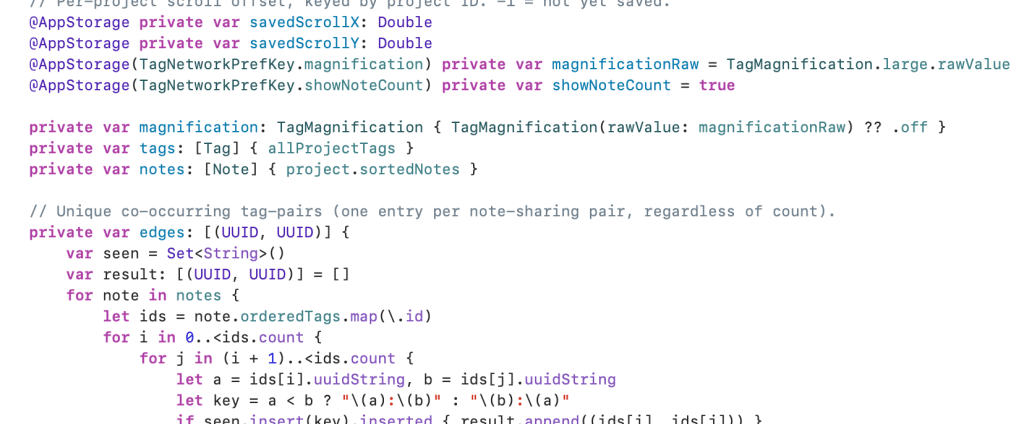
However, the gobbledegook seemed to work and the app slowly, almost miraculously, took shape, eventually becoming something that did exactly what I wanted. I can index pages of my notebooks and find those pages later from within the app using tags or combinations of tags. Claude and I identified some other use-cases: the app could be used for creative writing, research or planning but I will happily admit it is a niche product. And while I am now a fully fledged, perhaps illegitimate (given my coding ignorance) app developer, enrolled in the the Apple Development Programme, I am also (in the considered opinion of most of my family and friends) a hopeless nerd.
What have I learned in this process?
The development was astonishingly easy. The barriers to developing the app without the AI would simply have been too high – was I interested enough to hire someone who could write code, to invest in their time and arrange meetings to review what they’d done. Emphatically no – this was a hobby project, a diversion from pelvic pain. Without AI, the app would not exist and humanity would perhaps have been… …well OK, no different.
The AI model wasn’t creative. It didn’t come up with ideas unless prompted specifically (“How do you think I should present my screenshots on the App Store?”). It would produce solutions but the wider ideas were mine. Sense checking the app’s human interface, deciding which features added value and which were distractions, and coming up with improvements on the initially very basic functionality was left to me. And while Claude was good at doing what was asked, it would sometimes get stuck in a programming doom loop going around in circles trying to fix something. It was up to me to decide when something wasn’t working or wasn’t worth the effort and pull it back (“This isn’t working, let’s go back and start again”).
Claude has a personality. For a UK user it can seem cloyingly exuberant and positive (“Great job”, “Good call”, “Great catch”, “Agreed”) though you can change this (“Be my sparring partner” gets a more assertive and in-depth analysis of the flaws in your thoughts) but it doesn’t criticise even when it has good reason to: when I asked whether I should patent my app, I think it might have legitimately snorted but instead came up with a (long) list of why this was not a good idea. Perhaps I’d have been more comfortable with an old fashioned British Cynicism and Passive Aggression mode.
But the most stark learning point, for someone who has been suspicious of AI, was how powerful and genuinely useful it was. I’ve since used it to review documents I have been writing and it has come up with real insights and legitimate viewpoints that I had not considered. I could have asked a colleague for these, but we are all so busy that I’d have waited weeks. My use of Claude has made me reconsider my Luddite tendencies, even if all the concerns I raised in my earlier post on AI remain. AI is a tool and I have enjoyed using it.
So there you have it. TagNotes, programmed with Claude and Claude Code. I suspect the app is not going to make me rich. Maybe only I will end up using it. I’m not expecting to be invited to give a keynote at WWDC 2027 and Windows users are out of luck because it’s OSX only. But it’s there, done, made and I am quite proud of it.
Go to the App Store, have a look and leave a review if you like. All reviews are welcome, even ones written in Old Fashioned British Cynicism. There’s a web-page (on this site) that tells you more about the app’s function. And if you are the first person to find the small bug, buried deep in the code, that irritatingly didn’t get squashed before release, let me know and I’ll send you an official AI generated TagNotes beta-tester certificate with a gold star on it for your appraisal folder. You’re welcome.


You must be logged in to post a comment.