
I have been a medical leader and manager for a few years now: an unexpected late career segue born initially out of necessity but latterly something I very much enjoy: the broadening of perspective as I have moved from consultant vascular radiologist to my current role has been revealing.
One of the things I have learned as I have moved deeper into this role is that communication between front-line colleagues and organisational management can be better. We sometimes seem to speak at cross purposes, misunderstand motivation or are not clear about expectations. In order to bridge this gap, here are ten tips to make sure you get the most out of your conversations with leadership and managerial colleagues.
1. Keep it as short as possible
I would have written a shorter letter, but I did not have the time
Blaise Pascal (probably), 1656
Healthcare leadership is busy and a lengthy brain dump is a heart-sink. Try to keep your communication short, pithy and to the point. Can you summarise, in a format that is digestible on a trip between floors, why the recipient of your communication needs to care as much about it as you do? This ‘Elevator Pitch’ may seem like a corporate Americanism but forcing yourself to focus on a core message is a good habit for public and private sector employees alike wherever they live. Spend some time condensing and refining yours, and if you cannot, ask yourself whether you really understand the problem.
There’s a difference between a business case, a board level paper and less formal communication like email but even complicated documents are often longer than they need to be. TL:DR is real, especially when a document consistently uses a paragraph to say what could be said in a sentence so if you want your document to be read by a human, keep it tight. If necessary you can make complexities accessible in an appendix without them getting in the way of the broader theme or argument.
2. Keep it simple
You are a subject-matter expert. Your leadership or managerial colleague may not be. Pathways, acronyms and technical terms are hard to digest and are a barrier to understanding so keep the language simple and precise and don’t assume knowledge. Even if you don’t use a formal SBAR (Situation, Background, Assessment, Response) format, bear these categories of information in mind when communicating, and don’t mix them up. Take your time to think what you want in response and ideally put that at the beginning. Do you want a decision? Some support? What is the purpose of the communication?
If you are sending an email, think about your addressee list, especially the carbon copy (Cc:) field. Are you Cc’ing someone in for a reason or is it just a habit? I’ve experimented with an automation that moves all emails into which I’m Cc’d out of my inbox into a separate folder that I only rarely review. I don’t think I have missed anything vital though there has been the occasional surprise.
3. Understand risk
One of the biggest challenges managing in healthcare is balancing risk across diverse operations, or more thematically between the fundamental ‘pillars’ of quality, finance, workforce and safety. Accurate and broadly comparable assessments of risk are vital to support decision making and prioritisation, especially when resources are tight.
Your organisation will almost certainly have a risk matrix like this:
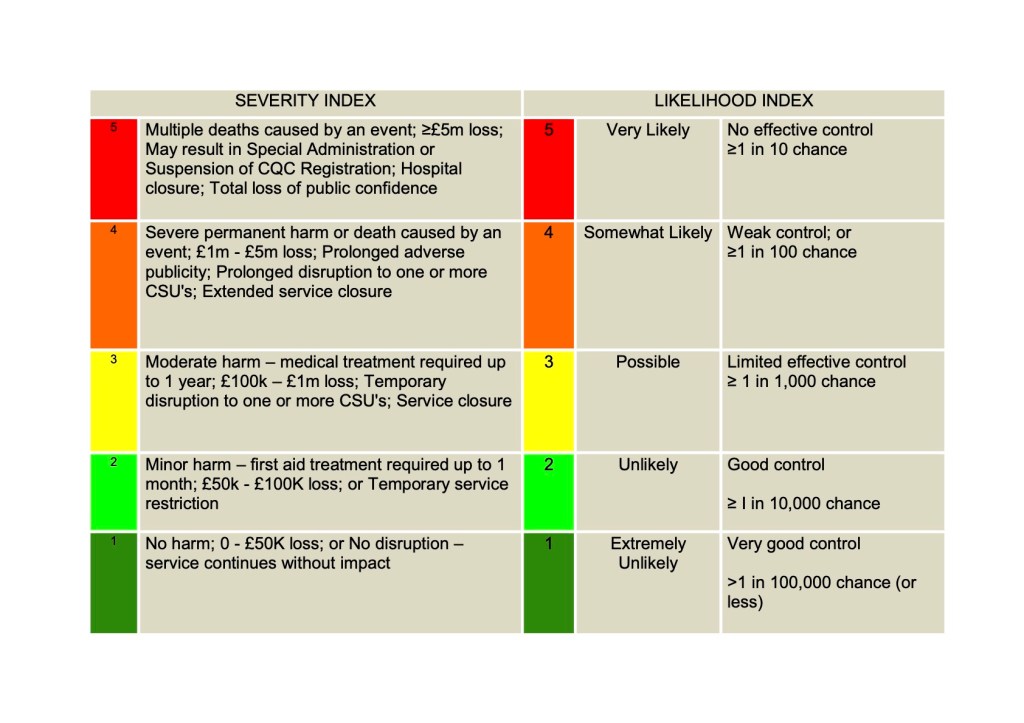
Learn how to use it and score risk correctly. Don’t artificially elevate your risk scoring in the hope this will get your issue noticed: crisis framing or shroud-waving is understandable behaviour when resources are tight but they undermine trust and confidence and longer-term render risk scoring useless. Something that’s scored at 25 is going to grab attention because that means there is a substantial or imminent risk of multiple deaths or closure of the entire hospital. Such risks are, in reality, rare in peacetime but are not uncommon in risk registers! If everything is important then nothing is.
4. Quantify
How big a problem is the thing you are talking about. Numbers are much more useful than adjectives, because one person’s ‘substantial’ is another person’s ‘marginal’. There is lots of data in healthcare: use it. Your department is likely to have accountancy, human resources and business staff who will have access this data and can help you.
If you are seeking resource, describe not just what you want but how much you want of it. Why have you settled on that amount and not half as much, or double? Be prepared to justify your request with modelling, a demand-capacity analysis or some other careful assessment. The larger the investment requested, the more rigorous the review of this will be so avoid guesstimates!
Quantification does not guarantee success: the narrative justification is just as important. But a narrative without data is just a story and is likely to be insufficient to generate enthusiastic leadership support.
5. Don’t use email for important communication
Email is terrible. There is so much of it and it’s hard to separate the signal from the noise. There are technical solutions to better communication (eg. apps like Slack, Teams or Monday) but unless your organisation makes a concerted pivot to one from another, they end up just being yet another channel to monitor.
If you have something important to communicate, pick up the phone or better still, arrange a meeting rather than clattering out an email. This gives the recipient a clue that this is something you feel warrants your time and therefore, perhaps, theirs.
Sending an email is rarely an action in itself or a fix for an issue. Don’t think that by sharing your issue you have absolved yourself of responsibility for its solution. This is called ‘Passing the Monkey’ and is rarely well received. In less enlightened times such communication might have been met with an irritated response along the lines of “feel free to cope”!
6. Understand your agency and present a solution
It’s easy to slip into passivity in the hope that someone will fix a problem for you or parachute in to provide an answer. In fact that’s rarely a good idea: the role of a leader is frequently to facilitate a team developing an answer for themselves within the context of the organisation’s overall strategic ambitions and priorities.
All consultants and other senior medical, nursing and allied health professional staff have a leadership role and share responsibility for addressing issues arising in their work. They have considerable agency in developing solutions, modelling behaviours and creating cultures. It’s vital that colleagues recognise this agency and use it, rather than passively escalating and hoping a solution will be provided or imposed.
This is not to suggest that all solutions lie entirely within a team’s capacity to resolve. The expectation is that as a necessary starting point teams to do what they can, where they are with what they have. Ideally, a team will proactively seek solutions and then present them to managerial colleagues as an options appraisal or a clear analysis of operational gaps and will then co-create solutions with leadership and managerial colleagues to mitigate these.
In the same vein…
7. Collaborate
Many issues straddle organisational boundaries. Improving access to theatre might involve estates, specialty teams, finance, anaesthesia and portering. Creating a new pathway in ED for early discharge might involve radiology, community services, primary care and IT.
Much of my role at the moment is getting people together and facilitating (or chairing) a conversation. If you want to create something, get all the stakeholders together and talk. This is now easy with videoconferencing and is hopelessly inefficient over email. Make sure you have all the right people in the room and don’t make assumptions about others’ perspectives or allow other people’s assumptions to go unchallenged. Listen as much as you speak and ensure there are good minutes.
A well worked up proposal created collaboratively between teams and shared for a decision is preferable to a leader being asked to come in and referee a disagreement, especially where no real attempt at prior collaboration has been made.
8. Be prepared for compromise, and possibly rejection
When collaborating, you may find that what you had originally planned is legitimately not possible. There may be insurmountable resource implications, staffing issues or regulatory hurdles to overcome that you might not have even begun to consider.
Agree compromises and know their consequences (eg. with a Quality Impact Assessment). Describe them clearly and succinctly so that a leadership or managerial colleague can easily understand (and sometimes take responsibility for) the risk in the decision. Avoid being too rigid, especially if failure to compromise will risk an entire project. Leaders will be interested in the overall impact even if the consequences for some stakeholders are not optimal. Bear this in mind when deciding where to draw your compromise ‘red lines’.
Sometimes the decision may be ‘we can’t do that’. While this can be disappointing, it at least allows you to park a project and not waste time pursue something that is unlikely to reach maturity. Frame it as an opportunity to pivot to something else.
9. Put patients at the centre
When you are deep in the detail of a business case, an organisational change, a pathway development or some other project, it’s easy lose perspective and forget what healthcare is for and who it serves. What you propose is important, but if a leader asks ‘so what’ you need an answer.
Keep as your guiding principle the delivery of quality, accessible, safe and compassionate healthcare and maintain this focus in all your interactions. If you can clearly articulate the benefits to patients and service users of what you are doing, that makes a leadership decision to support it much easier. Your organisation will have a strategic goal which almost certainly will (should!) have patients and staff at its centre and leaders will want assurance that your project aligns with this.
10. Invest in the relationship
This is perhaps the most important tip of all: a good working relationship between leadership and managerial colleagues and the teams they lead is essential.
Trust, mutual respect, openness, honesty, reliability and understanding are essential for professional relationships to thrive and be productive. Without these attributes, all the tips offered above will fail. This does not mean only focussing on the positives and avoiding difficult issues: in fact the opposite is true. If you and your leadership colleagues can foster a culture where difficult conversations can be had in the same spirit of psychological safety as easy ones, if you can hold each other accountable and if you can give and accept challenge with an open and growth mindset rather than a closed fixed one you are well on the way to being a powerfully effctive team.
This doesn’t mean you need to socialise together or make idle conversation for 5 minutes at the start of every meeting: it means demonstrating behaviours, and expecting these behaviours in return, that will allow your relationship to flourish.




You must be logged in to post a comment.